


Mobility Exercises for Stiff Squat Depth: 7 Fixes

Last Updated: October 23, 2026
Quick Summary
The best mobility exercises for stiff squat depth target the ankles and hips, not the hamstrings. Start with a 3-minute screen, then use knee-to-wall ankle rockers, 90/90 hip rotation, rolling Cossack squats and goblet prying squats in a 10 to 15 minute routine, ankles first.
- Run the 3-minute depth screen before stretching anything to find whether ankles, hips or proportions limit you.
- Knee-to-wall ankle rockers: 3 sets of 10 slow reps per side with the heel down.
- Hold a deep squat 30 to 60 seconds per set and train it three to five times per week.
- Progress one variable at a time: add time before load, and load before frequency.
- Film side-on squats before week one and again after four weeks to test transfer.
Table of Contents
- Why Your Squat Depth Is Stuck (and How to Test It)
- Ankle Mobility Exercises for Squats That Actually Move the Needle
- Hip Mobility Drills: Flexion, Rotation, and Adductors
- Your Deep Squat Mobility Routine, Step by Step
- The 10-Minute Squat Mobility Routine You Can Do Anywhere
- How Long to Hold a Deep Squat (and How Often to Train It)
- When Stiffness Is Pain: Red Flags and What to Do
- Conclusion
- Frequently Asked Questions
Why Your Squat Depth Is Stuck (and How to Test It)
Most lifters blame tight hamstrings for a shallow squat, but mobility exercises for stiff squat depth usually target the ankles and hips instead. That is usually wrong.
At Vitalyns, we build recovery and mobility gear for athletes who train hard and want to move better. Here is the honest starting point: you cannot fix a depth problem you have not diagnosed.
Squat depth is how far you can lower your hips while keeping your heels down and your spine neutral. If depth stalls, the cause is usually one of four things:
- Ankle stiffness. Your shin cannot travel forward over your foot.
- Hip restriction. Your hip joint runs out of flexion or rotation.
- Technique. You are reaching for depth instead of sitting into it.
The 3-Minute Depth Screen: Ankles, Hips, or Proportions?
Run this test before you stretch anything. It tells you which drill matters.
- Wall ankle test. Face a wall with your toes about 10 cm back. Drive your knee toward the wall. Heel stays down. If the knee stops short, your ankle is the limit.
- Heels-elevated squat. Squat with your heels on a small wedge or book. If depth improves a lot, ankles were the problem.
- Wide-stance squat. Widen your feet and turn your toes out. If depth gets easier, your hips or hip rotation need work.
- Goblet squat with a light load. If a light weight at your chest drops you lower, the issue is balance or bracing, not tissue.
Mobility Restriction vs Technique, Balance, or Strength
A mobility restriction is a hard stop. You push and nothing moves, and you feel a pinch or a block in the joint.
Technique and balance problems feel different. You wobble, your heels lift, or your chest dumps forward.
Here is the difference in practice: if a heel lift or a wider stance instantly buys you depth, you are dealing with position, not tissue.
Ankle Mobility Exercises for Squats That Actually Move the Needle
Ankle mobility exercises for squats work best when they load the joint, not just stretch it.
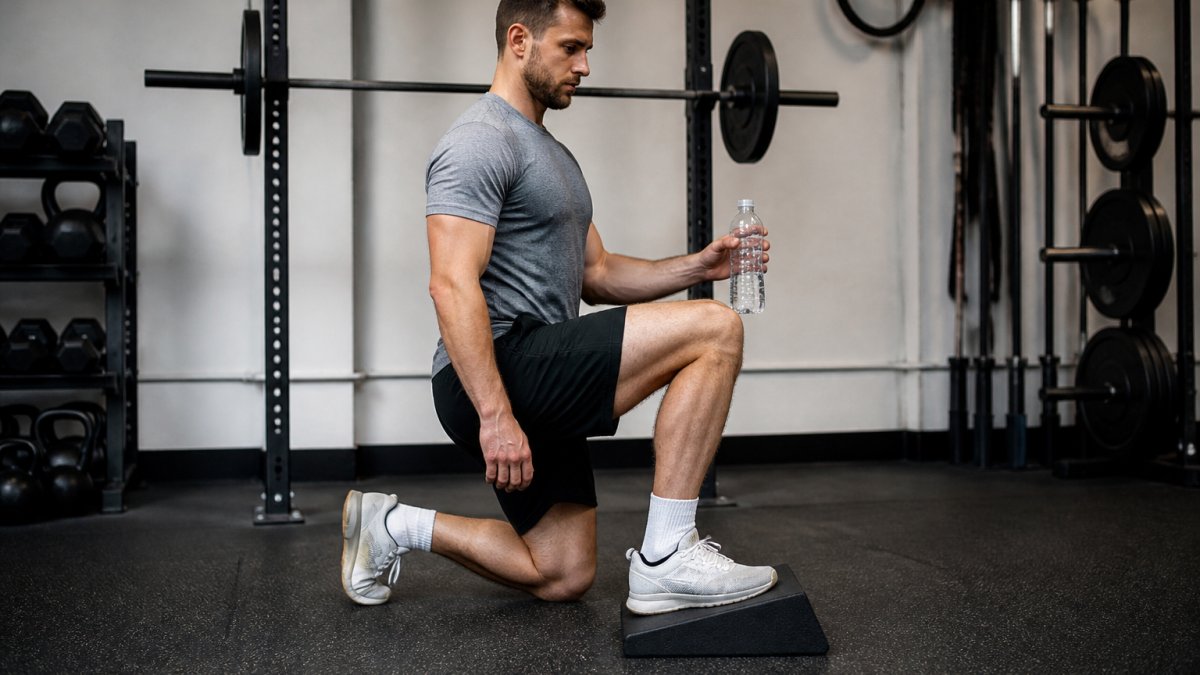
Two drills cover most of it:
- Knee-to-wall ankle rocker. Toes a few centimetres from the wall, heel down, drive the knee to touch. 3 sets of 10 slow reps per side.
- Weighted ankle rocker. Same setup, but sit a light plate or kettlebell on the knee. This is the version that transfers to a loaded squat.
- Half-kneeling ankle rocker. Back knee down, front foot flat, rock the front shin forward. Great for finding the restriction one leg at a time.
A slant board or wedge makes this easier to dose. Our 3-piece adjustable squat wedge block stacks to 8.5° or 17° of tilt, so you can start shallow and progress.

If your calves and Achilles are the tight link, our adjustable incline board offers four tilt positions from 20° to 45° and folds flat for travel.

Hip Mobility Drills: Flexion, Rotation, and Adductors
Hip mobility for squats comes down to three jobs: flexing deeply, rotating outward, and opening the adductors. Skip any one and your bottom will feel stuck.
The drills that earn their place:
- 90/90 hip rotation. Sit with both knees bent at 90°, rotate side to side without using your hands. 8 slow switches per side.
- Pigeon pose. Hold 45-60 seconds per side. Targets the glutes and outer hip.
- Rolling Cossack squat. Shift side to side with one leg straight, hips back. This one hits adductors and ankle together.
A light resistance band around the knees gives you something to push against in the 90/90 and the prying squat. Our latex resistance band set runs from extra light to extra heavy, packs into a mesh bag, and travels in a backpack without taking space.

Your Deep Squat Mobility Routine, Step by Step
A routine of mobility exercises for stiff squat depth should take 10 to 15 minutes and hit ankles first, hips second. Order matters: if the ankle is locked, the hip cannot express its range.
| Step | Drill | Dose | Why It Comes Here |
|---|---|---|---|
| 1 | Knee-to-wall ankle rocker | 2 x 10 per side | Unlocks forward shin travel |
| 2 | Weighted ankle rocker | 2 x 8 per side | Loads the new range |
| 3 | 90/90 hip rotation | 8 per side | Wakes up hip rotation |
| 4 | Rolling Cossack squat | 6 per side | Adductors plus ankle |
| 5 | Goblet prying squat | 3 x 30 sec hold | Ties it together under load |
| 6 | Bodyweight squat, full depth | 2 x 5 slow reps | Tests the transfer |
The last step is the one people skip. Mobility work only counts if it shows up in the actual movement. Finish every session with slow bodyweight squats and check whether your bottom is lower than when you started.
The 10-Minute Squat Mobility Routine You Can Do Anywhere
This 10-minute squat mobility routine needs no rack and no gym. It works in a hotel room, an office, or a warm-up corner.
3pcs Squat Wedge Block Adjustable Non-Slip Squat Ramp Deadlift Wedge Calf →
- Minutes 1-2: Half-kneeling ankle rockers, 10 per side.
- Minutes 3-4: Deep squat hold with heels elevated on a wedge or book, 2 x 45 seconds.
- Minutes 5-6: 90/90 hip rotation, 8 switches per side.
For travel days, a stretching strap helps you reach positions you cannot get into cold. Our adjustable hamstring stretcher strap has a wooden handle and a foot loop, so you can hold a hamstring or calf stretch without rounding your back to reach your toes.
How Long to Hold a Deep Squat (and How Often to Train It)
Hold a deep squat for 30 to 60 seconds per set, and train it three to five times per week. Shorter holds build tolerance; longer holds build comfort in the bottom position. But hold time alone is not a plan. To make depth stick, pair the hold with a simple weekly progression and a transfer test that tells you whether the new range shows up in a loaded squat.
A 4-Week Deep Squat Hold Progression
Use this progression if your goal is a deeper bodyweight or goblet squat bottom. Keep the same stance and heel position each week so you are comparing like with like.
| Week | Frequency | Hold dose | Load | Focus |
|---|---|---|---|---|
| 1 | 3 sessions | 3 x 30 sec | Bodyweight | Find a braced, active bottom |
| 2 | 3 sessions | 3 x 40 sec | Bodyweight | Add 10 sec per hold; keep heels down |
| 3 | 4 sessions | 3 x 45 sec | Light goblet (5-10 kg) | Hold load at chest; pry knees out gently |
| 4 | 4 sessions | 3 x 60 sec | Light goblet (5-10 kg) | Own the bottom; test transfer |
Progress one variable at a time: add time before load, and load before frequency. If a week feels sloppy, repeat it rather than pushing forward. Most practitioners find that range of motion responds to frequent, submaximal exposure rather than one long weekly session.
How to Test Whether the Holds Transfer to Loaded Squats
Mobility work only counts if it changes the actual movement. Before your first session of the week, film a side-on set of 5 bodyweight squats and 5 goblet squats at a light load. Use the same camera height and stance each time. After four weeks, repeat the same sets and compare:
- Bottom height: Is your hip crease lower relative to your knee than in the first video?
- Heel contact: Do your heels stay down without a wedge?
- Torso position: Is your chest more upright at the same depth, or are you still dumping forward?
If the holds improve but the loaded squat does not change, the limit is likely technique or strength rather than tissue. In that case, spend two weeks on tempo squats and bracing before adding more mobility volume. If the loaded squat improves, keep the hold progression and add 5 kg to your goblet squat every two weeks.
Treat the deep squat hold like a lift: progress time, then load, then frequency, and test transfer with video every four weeks. A hold that never shows up in a loaded squat is just a stretch.
When Stiffness Is Pain: Red Flags and What to Do
Stiffness that eases as you warm up is normal. Pain that sharpens, pinches, or lingers is not. The practical question is not whether something hurts, but whether the pain behaves like a tissue irritation or like a joint problem that needs assessment.
Normal Stiffness vs. a Joint Problem
Normal stiffness usually:
- Eases within 5 to 10 minutes of movement
- Feels muscular and broad, not sharp or pinpoint
- Improves with gentle range of motion and worsens with long sitting
A joint problem more often:
- Produces a sharp pinch at end range, especially in the front of the hip
- Persists after training or wakes you at night
- Comes with numbness, tingling, or weakness in the leg
If you are in the second group, stop the deep squat holds and get assessed by a physiotherapist or sports doctor. Self-treatment on a symptomatic joint can make it worse.
What to Do in the First 48 Hours
If a squat or mobility session leaves you with new pain, use a simple load-management approach:
- Back off range and load. Switch to pain-free range for 2 to 3 days. Do not force the bottom position.
- Keep moving gently. Short, frequent sessions of easy ankle and hip motion are usually better than complete rest.
- Avoid aggressive stretching and deep holds. Pushing into a pinch at end range irritates the joint.
- Recheck daily. If pain is easing and range is returning, resume your normal routine gradually. If it is unchanged or worse after 48 hours, seek assessment.
Returning to Mobility Work Safely
When pain settles, return in this order: pain-free range first, then control, then load, then depth. A simple return-to-depth sequence is:
- Days 1-3: Pain-free ankle rockers and 90/90 rotations, 2 x 8 per side.
- Days 4-7: Add bodyweight squats to a comfortable depth, 2 x 5 with a 3-second pause.
- Week 2: Add light goblet squats and short deep squat holds at a depth that stays pain-free.
Do not use a massage gun directly on the front of the hip, the lower back, or any joint. Work the muscle belly, keep it moving, and stop if it hurts. Massage guns and red light therapy support recovery in healthy tissue; they are not a treatment for an injury and do not replace a professional assessment.
Conclusion
Depth is a skill built from range, control, and consistency, not from one aggressive stretch session. Screen first, train the ankle and hip drills that match your limit, and hold your deep squat long enough to make it stick.
Vitalyns builds the gear that supports that work: a stackable squat wedge for ankle and calf work, an adjustable incline board for home and travel, and resistance bands that fit in a backpack.
Frequently Asked Questions
How long should you sit in a deep squat?
Start with 30 seconds and build toward 2 to 3 minutes per set, two or three times a day. If your heels lift or your lower back rounds hard, hold a doorframe or squat with your heels on a small wedge until the position opens up. Accumulating 5 to 10 total minutes of deep squat holding per day is a realistic target for most lifters. Stop the hold if you feel pinching in the front of the hip or sharp knee pain, and work on the ankle and hip drills instead.
How often should I do squat mobility exercises?
Four to six sessions per week works well, and short daily sessions beat one long weekly block. Run the 10-minute squat mobility routine before training as preparation, and put the longer holds and hip openers after training or in the evening. Ankle rocking and goblet squat prying can be done daily because the load is low. Give yourself 4 to 8 weeks of consistent work before judging results, and retest your depth with a bodyweight squat every two weeks to track change.
Why can't I squat deeply without my heels lifting?
Heels lifting usually points to limited ankle dorsiflexion, not tight quads. When the shin cannot travel forward over the foot, the body shifts weight to the toes to reach depth. Test it in a half-kneeling ankle rocker: if the knee stops well short of the wall with the heel down, ankles are your limiter. Weighted ankle rockers, calf stretches on an incline board, and temporarily squatting with heels elevated all help. Fix the ankle and depth often appears within a few weeks.
Can ankle mobility affect squat depth?
Yes, and it is the most common single limiter. Squatting to depth requires roughly 35 to 45 degrees of dorsiflexion with the heel planted. Lifters below that threshold either lift the heels, widen the stance excessively, or lean far forward to compensate. Ankle rocker drills, calf and soleus stretching, and squatting with a heel wedge build the range back. Once dorsiflexion improves, most people find their squat mobility work transfers directly into a deeper, more upright loaded squat.
