


How to Improve Squat Depth With Mobility

Table of Contents
- Why You Can't Hit Depth (And How to Find Your Limiting Factor)
- Ankle Mobility for Squats: The Most Common Depth Blocker
- Hip Mobility for Squats: Opening the Bottom Position
- Squat Mobility Exercises: Drills That Transfer to the Barbell
- The 15-Minute Squat Mobility Routine (With Checkpoints)
- Stance, Heel Elevation, and Squat Variations That Buy Depth
- Common Mistakes, Pain Signals, and When to Get Assessed
- Conclusion: Move Better, Recover Faster, Squat Deeper
- Frequently Asked Questions
Last Updated: October 12, 2026
Why You Can't Hit Depth (And How to Find Your Limiting Factor)
Most lifters blame tight hips for a shallow squat, but the real blocker is often elsewhere. Learning how to improve squat depth with mobility starts with one question: which joint is actually stopping you?
A squat depth limitation is any restriction that stops your hips from dropping below parallel while your heels stay down and your torso stays upright. It usually comes from one of three places: ankles, hips, or upper back, and sometimes it is not mobility at all.
A 5-Minute Self-Assessment: Ankle, Hip, or Thoracic?
Answer three quick tests in front of a wall or mirror. No equipment needed.
- Ankle test: Face a wall, toes about 10 cm away. Drive your knee toward the wall without lifting your heel. Heel lifts early? Your ankle is likely the blocker.
- Hip test: Lie on your back and pull one knee to your chest, then out to the side. A hard stop or pinching means hip mobility needs work.
- Thoracic test: Stand with your back to a wall, arms overhead. If your lower back arches hard to get your arms up, your upper back is limiting your torso position.
Whichever test feels worst is your starting point. Retest every two weeks.
Mobility Restriction vs. Strength, Balance, or Body Proportions
Not every shallow squat is a mobility problem. A true mobility restriction means a joint physically cannot reach the position. A strength or balance issue means it can get there but you cannot control it under load.
Quick check: can you hit depth with just your bodyweight and heels elevated? If yes, your joints have the range. Your problem is control, strength, or stance, not flexibility.
Ankle Mobility for Squats: The Most Common Depth Blocker
Ankle mobility for squats is the most overlooked fix. Limited ankle dorsiflexion forces your heels up or your torso forward, and both kill depth. The knee-to-wall test tells you how much range you have: face a wall, toes a few centimetres back, drive your knee forward. If your heel lifts before your knee touches, you have work to do.
Knee-to-Wall Test and Calf Stretches That Work
Run the test, then train the range you lack. Move your foot back until your knee just touches the wall with your heel down, that is your baseline.
Then work these:
- Knee-to-wall rocks: 3 sets of 10 per side, knee driving over the toe, heel glued down
- Standing calf stretch: 3 sets of 30 seconds per side on a step or wedge
- Loaded calf stretch: hold a light weight while you stretch for a deeper pull
The NHS guidance on stretching and flexibility is a solid starting point for how long to hold each stretch.
A slant board or wedge makes this easier and more consistent. Our 3pcs Squat Wedge Block Set stacks to 8.5° or 17°, so you can raise your heels for squat practice and stretch your calves on the same tool.

Hip Mobility for Squats: Opening the Bottom Position
Hip mobility for squats decides how comfortably you sit in the bottom position. Tight hip flexors, adductors, and internal rotators pull your pelvis into a position that rounds your lower back. You do not need to be Gumby, you need enough hip range of motion to keep your torso upright and your knees tracking over your toes.
First, Separate a Hip Mobility Restriction From a Strength or Proportion Issue
Before you stretch, run this quick check. It saves months of chasing the wrong fix.
- Bodyweight deep squat with heels elevated: If you can sit at the bottom with heels on a wedge and your torso upright, your hip joint has the range. Your limitation is control, strength, or stance, not flexibility.
- Supine knee-to-chest: A hard stop before your thigh reaches your ribs suggests a true hip mobility restriction. A soft end feel with no pinching usually means the joint can move further but your muscles are guarding.
- 90/90 position: If one hip cannot rotate to the floor without your pelvis shifting, that side has an internal or external rotation restriction.
Lifters with a pinching sensation at the front of the hip often have adequate range but poor control at end range. Stretching harder makes it worse, you need active strength in the new range, not more passive length.
Hip Flexor, Adductor, and Internal Rotation Drills
Three drills cover most of what a squat demands, each with a regression and progression.
-
Half-kneeling hip flexor stretch
- Setup: half-kneeling, back knee under your hip, front foot flat.
- Execution: squeeze the glute of the back leg to tilt your pelvis, then gently shift forward.
- Dose: 3 sets of 30 seconds per side.
- Regression: do it standing with a chair for balance.
- Progression: raise the back foot onto a low bench.
- Common mistake: arching the lower back instead of tucking the pelvis.
-
Adductor rock-back
- Setup: on all fours, one leg out to the side with the knee straight.
- Execution: rock back toward the extended leg, then forward.
- Dose: 10 slow reps per side.
- Regression: reduce the range and keep the hips high.
- Progression: place the extended foot on a low wedge to increase the stretch.
- Common mistake: letting the lower back round instead of hinging from the hips.
-
90/90 hip rotations
3pcs Squat Wedge Block Adjustable Non-Slip Squat Ramp Deadlift Wedge Calf →
- Setup: sit with both knees bent at 90 degrees, one leg in front, one to the side.
- Execution: rotate side to side slowly, keeping your chest tall.
- Dose: 10 slow reps per direction.
- Regression: support your torso with your hands behind you.
- Progression: lift both hands off the floor and rotate without support.
- Common mistake: rushing the rotation and using momentum instead of control.
Transfer the Range to Your Squat
Mobility drills only matter if they change how you squat. After your hip work, do two sets of 10 bodyweight squats with a resistance band around your knees, pushing your knees out and sitting into the deepest position you can control with your heels down.

Our resistance band set comes in five levels from extra light to extra heavy, so you can start light and progress as your control improves. The band teaches your hips the bottom position under light tension, the bridge between passive range and loaded squats.
Squat Mobility Exercises: Drills That Transfer to the Barbell
Squat mobility exercises only matter if they change how you squat under a bar. Passive stretching alone rarely transfers. The drills below build range and control at once, each with a regression, a progression, and the mistake that cancels the benefit. Do them before you lift, not instead of lifting.
1. Deep Squat Hold
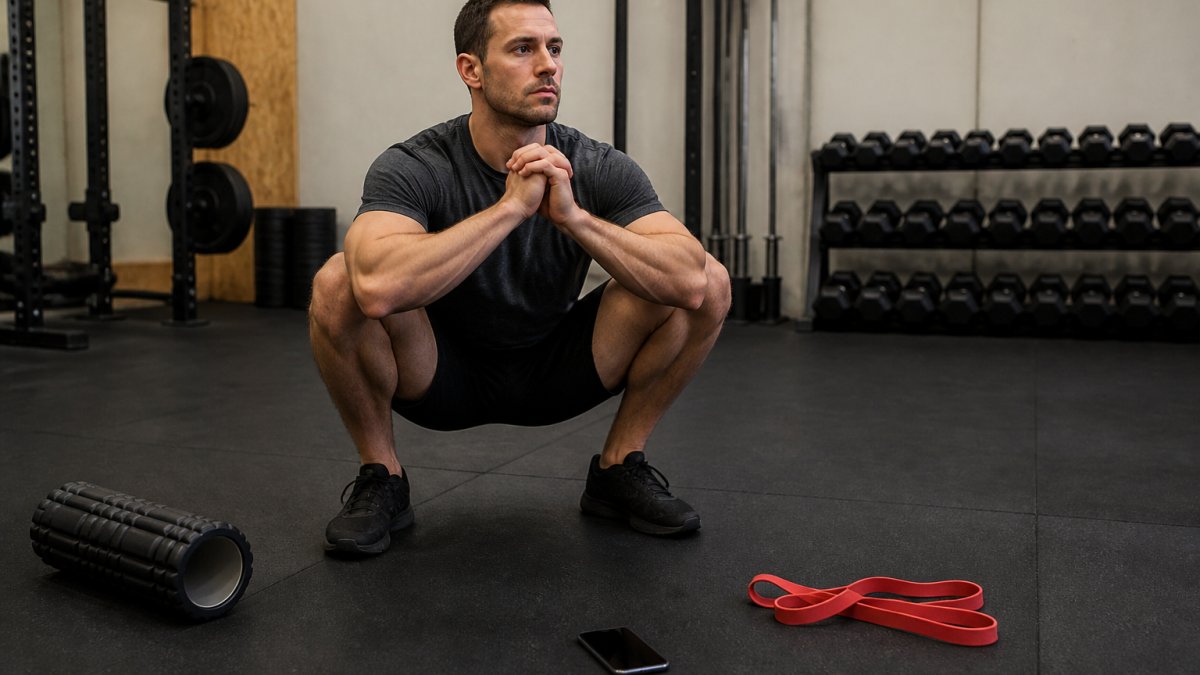
- Setup: Stand with feet shoulder-width apart, toes slightly out. Lower into the deepest squat you can hold with heels down and chest as tall as possible.
- Execution: Sit at the bottom and breathe. Use your elbows to gently push your knees out if needed.
- Dose: 30-60 seconds, 2-3 rounds.
2. Rocking
- Setup: From the bottom of a deep squat, keep your heels down and hands together in front of your chest.
- Execution: Rock forward and back slowly, exploring the range without losing your foot position.
- Dose: 10-15 rocks, 2 rounds.
3. Crab Swings
- Setup: On all fours with hips high, knees bent, feet flat.
- Execution: Shift your weight side to side, opening one hip at a time.
- Dose: 10 swings per side, 2 rounds.
4. Foam Roller Work
- Setup: Place the roller under your quads, adductors, or calves.
- Execution: Roll slowly for 60 seconds per area, pausing on tight spots.
- Dose: 60 seconds per muscle group.
Our 45 cm foam roller handles the quad, adductor, and calf work in one tool. Roll before your session to prep tissue, then again after training.
How to Transfer New Range to Loaded Squats
This is the step most guides skip. You have new range from the drills above, now use it under load without losing it. Follow this progression over 4-6 weeks:
- Week 1-2: Bodyweight deep squat holds, 3 sets of 30 seconds, daily.
- Week 3-4: Goblet squats with a light kettlebell or dumbbell, 3 sets of 8, focusing on holding the bottom for 2 seconds.
- Week 5-6: Barbell back squat or front squat with an empty bar or light load, 3 sets of 5, pausing at the bottom for 1 second.
At each stage, film your squat from the side. If your heels lift or your lower back rounds, drop back a stage for a week. Own the range before you add load.
The 15-Minute Squat Mobility Routine (With Checkpoints)
This 15-minute squat mobility routine covers ankles, hips, and upper back in one session. Run it before squat days, or daily if depth is your main goal.
| Block | Time | Drill | Checkpoint |
|---|---|---|---|
| Ankles | 4 min | Knee-to-wall rocks, calf stretch | Heel stays down, knee reaches wall |
| Hips | 5 min | Hip flexor, adductor, 90/90 drills | No pinching at end range |
| Upper back | 2 min | Foam roller extensions | Arms reach overhead without arching |
| Practice | 4 min | Deep squat hold, rocking | Hold 30 seconds, heels down |
Retest every two weeks. If your knee-to-wall distance grows or your squat hold gets easier, the routine is working.
Stance, Heel Elevation, and Squat Variations That Buy Depth
Sometimes the fastest fix is not more mobility but a better position. Stance width and toe angle change how much hip range you need. Heel elevation reduces the ankle demand. Both are legitimate tools, not cheats.
- Widen your stance: more room for your hips to drop between your legs
- Turn toes out slightly: opens the hip joint and reduces pinching
- Elevate your heels: a wedge or squat shoes reduce ankle demand
A heel wedge is the most effective shortcut for ankle-limited lifters. Our adjustable incline board offers four tilt positions from 20° to 45°, so you can match the angle to your ankle range and progress as it improves.

Common Mistakes, Pain Signals, and When to Get Assessed
Most squat depth stalls come from a handful of repeatable errors. Fixing them is faster than adding more stretches.
- Stretching only, never practicing: range you never use disappears
- Ignoring the ankles: the most common blocker and the easiest to fix
- Forcing depth with a rounded back: trades mobility for injury risk
Pain is different from effort. A deep stretch or mild pinch at end range is normal. Sharp pain, numbness, or pain that lingers after training is not. The NHS information on back pain is a useful reference for what warrants a professional look.
Conclusion: Move Better, Recover Faster, Squat Deeper
Depth is a skill you build, not a gift you are born with. Find your limiting joint, train it daily, and use stance and heel elevation while you wait for range to arrive.
Vitalyns builds recovery and mobility gear for exactly this work. Our five collections cover massage guns, red light therapy, and the wedges, bands, and rollers in this guide, all designed to help you reset your body, improve mobility, and recover between sessions.
Get started with Vitalyns and build the range that lets you squat deeper, safer, and stronger.
Frequently Asked Questions
How long does it take to improve squat depth with mobility work?
Most lifters notice a measurable change in squat depth within 4 to 6 weeks of consistent work. Train squat mobility 4 to 5 times per week for 10 to 15 minutes per session, and re-test your depth every two weeks. Ankle and hip restrictions often respond first because the drills are joint-specific. If nothing changes after 8 weeks of daily practice, the limit is likely strength, balance, or your body proportions rather than mobility, and a qualified coach or physiotherapist should assess it.
Which squat mobility exercises help you squat deeper?
The highest-value squat mobility exercises are deep squat holds, ankle knee-to-wall rocks, calf stretches off a step, hip flexor and adductor stretches, and thoracic rotations. Pair them with loaded work like goblet squats and pause squats so the new range of motion transfers to the barbell. Perform 2 to 3 sets of each drill, holding 30 to 60 seconds, and finish with 5 minutes of deep squat position practice. Consistency matters more than session length.
How can ankle mobility affect squat depth?
Limited ankle dorsiflexion forces your heels to lift or your torso to pitch forward before you reach depth. Test it with the knee-to-wall drill: if your knee cannot travel roughly 10 cm past your toes with the heel down, ankle mobility is limiting your squat. Calf stretches, ankle rocks, and heel elevation tools like squat wedges can restore range quickly, letting you sit into the bottom position with an upright torso.
When should limited squat depth be assessed by a healthcare professional?
See a physiotherapist or sports doctor if you feel sharp pain, pinching, or clicking in the hip, knee, or lower back at the bottom of a squat, or if depth stops improving after 8 weeks of consistent mobility work. Also seek assessment if you have a history of hip impingement, ankle sprains, or back injury. Mobility gear supports recovery and range, but it does not diagnose or treat joint problems.