


How to Fix Compensatory Movement Patterns

Last Updated: November 12, 2026
Quick Summary
To fix compensatory movement patterns, first film yourself from the front and side running five checks: overhead reach, squat, single-leg stance, sit-to-stand, and gait. Then retrain the pattern three times per week through four phases: mobilise, activate, integrate, and load. A compensatory movement is any substitute strategy your body uses when a joint or muscle can't do its share of the work.
- Stop any assessment test that produces sharp pain, numbness, tingling, or joint pinching.
- Film from the side too, since a front view hides torso fold and heel lift.
- Do the correction sequence three times per week on non-consecutive days.
- Video your squat from the side every two weeks and compare the faults.
- Book a physiotherapist if pain persists beyond a couple of weeks or a limb goes numb.
Table of Contents
- Step 1: Self-Assess Your Compensatory Movement Patterns Safely
- Compensatory Movement Examples to Recognize in Your Training
- Movement Pattern Correction Exercises for Whole-Body Retraining
- Frequently Asked Questions
Step 1: Self-Assess Your Compensatory Movement Patterns Safely
Learning how to fix compensatory movement patterns starts with seeing them clearly. A compensatory movement pattern is any substitute strategy your body uses when a joint or muscle can't do its share of the work.
Total time: 15-20 minutes. Difficulty: Beginner.
What You'll Need
- A phone to record video from the front and side
- A clear wall and about two metres of floor space
- A chair or box for sit-to-stand
The Assessment Sequence
Run these five checks in order, filming each from the front and side.
- Overhead reach against a wall: heels, hips, and upper back touching; raise both arms without arching your lower back. Rib flare or arms that can't reach the wall signal a mobility restriction. 2. Bodyweight squat, side view: watch for heels lifting, knees caving inward, or early torso fold. 3. Single-leg stance, 10 seconds each side: note hip drop or excessive wobble. 4. Sit-to-stand from a chair, arms crossed: look for one knee drifting inward or the torso diving forward. 5. Walking gait, 20 steps: check for uneven stride length, heavy heel strike, or a sharply turned-out foot.
Safety Limits
Stop any test that produces sharp pain, numbness, tingling, or joint pinching. Muscle effort is fine. Joint pain is not.
Watch out: Filming only from the front hides the most common faults, the forward torso fold and heel lift in a squat are only visible from the side.
If you're self-assessing shoulder mechanics after a CrossFit injury, our guide on preventing shoulder injuries in CrossFit covers what to look for before you load the joint again.
Compensatory Movement Examples to Recognize in Your Training
Recognizing compensatory movement examples in your own training is faster than any lab test. Movement dysfunction rarely shows up as one isolated fault, it shows up as a cluster.
- Knee valgus in the squat: knees drift inward on the drive up, usually a hip control issue.
- Early heel lift in the squat: an ankle mobility limitation forcing the body forward.
- Lower back arch in the overhead press: ribcage flares because the shoulders can't reach full range.
When Compensation Is Useful Versus Harmful
Not every compensation needs fixing.
A compensation is useful when it's temporary and task-specific, like limping for a week after an ankle sprain while tissue heals.
Common Causes Behind Faulty Movement Patterns
Muscle weakness, joint stiffness, limited range of motion, and past injury all drive compensation.
That rerouting is why symptom management alone rarely works: a tight muscle can return if the underlying cause is a stiff ankle.
For lifters working on squat depth specifically, resistance bands for squat hip mobility can support the hip work that addresses the root cause rather than the symptom.
Movement Pattern Correction Exercises for Whole-Body Retraining
Correcting movement patterns means retraining the strategy, not just strengthening isolated muscles. Slow the tempo, reduce the load, and rebuild from the ground up.
The sequence below moves from mobility to stability to integration. Do it three times per week on non-consecutive days.
| Phase | Goal | Example Exercise | Tempo | Duration |
|---|---|---|---|---|
| 1. Mobilise | Restore range of motion | Ankle wall drill, hip flexor stretch | Slow, 2-second hold | 5 min |
| 2. Activate | Wake up weak muscles | Glute bridge, banded lateral walk | 3 seconds up, 3 down | 8 min |
| 3. Integrate | Rebuild the pattern | Goblet squat with tempo, split squat | 4 seconds down, 1 up | 10 min |
| 4. Load | Test under resistance | Loaded carry, step-up | Controlled | 7 min |
Phase 1: Mobility First
You can't retrain a pattern through a restriction. Spend five minutes opening the joints that showed up in your assessment.
Phase 2: Activation
Weak muscles need to switch on before they can carry load. Keep the effort low and the control high.
Phase 3: Integration
This is where movement pattern correction exercises actually stick. Slow, controlled movement teaches your nervous system the new strategy.
- Tempo goblet squat: 3 sets of 6
- Split squat: 3 sets of 8 per leg
- Single-leg Romanian deadlift: 3 sets of 6 per side
A stretching strap can be used for hamstring work in this phase. Our guide on how to use a stretching strap for hamstrings walks through the setup.
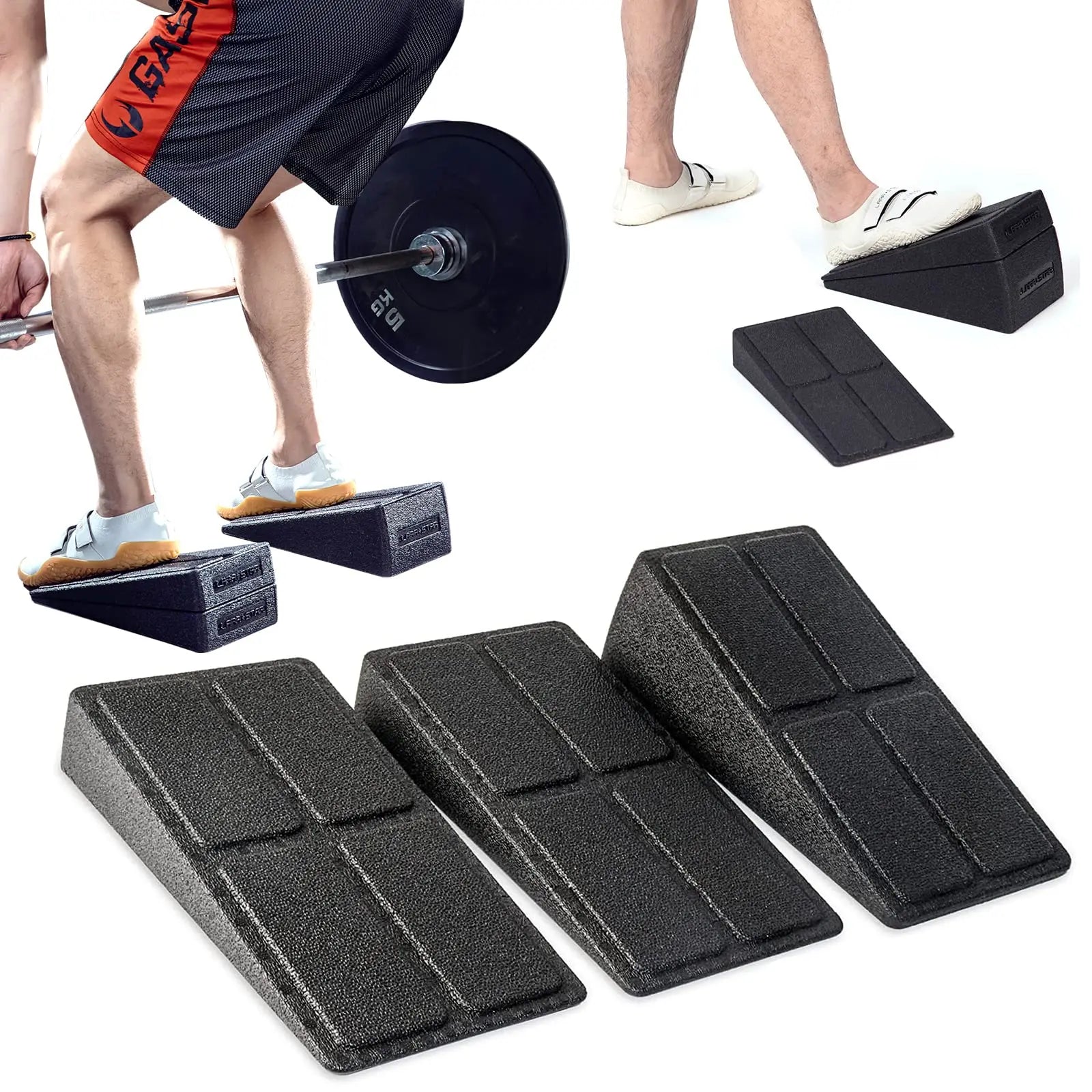
For squat and deadlift positioning, an adjustable wedge can provide an angled surface to train against. The adjustable non-slip squat wedge block is listed for squat and deadlift training.
Phase 4: Load and Measure Progress
Progress isn't a feeling. Track these markers:
- Video your squat from the side every two weeks and compare
- Note whether heel lift or knee valgus appears at the same load
- Time your single-leg stance and check for wobble
If the fault shows up later in a set than it did a month ago, the pattern is improving. That's measurable progress even when the mirror looks the same.
For a deeper set of mobility fixes, this collection of mobility exercises for stiff squat depth pairs well with the phases above.
Prehab Exercises List for Injury Prevention
Once the pattern is corrected, keep it corrected with a short prehab exercises list before training:
- Banded ankle mobilisation, 10 reps per side
- Glute bridge with band, 12 reps
- Banded lateral walk, 10 steps each way
Five minutes. That's the whole cost of keeping a good pattern good.
When to See a Professional
Some patterns need hands-on help. Book an assessment with a physiotherapist or movement specialist if you notice:
- Pain that persists beyond a couple of weeks
- Numbness, tingling, or weakness in a limb
- A pattern that worsens despite consistent corrective work
Self-assessment has limits. A trained eye catches what a phone camera can't.
Compensation doesn't fix itself, it quietly becomes your default until something else breaks. The athletes who stay durable treat recovery and mobility as part of training, not an afterthought. Vitalyns offers a recovery and mobility system across five collections, designed to help you reset your body after effort, improve mobility, and support muscle recovery.
Frequently Asked Questions
What is a compensatory movement pattern?
A compensatory movement pattern is when your body recruits a different muscle or joint to complete a task because the primary mover is weak, tight, or restricted. For example, your lower back may arch during an overhead press if your shoulders lack range of motion. These faulty movement patterns can feel normal but often lead to muscle imbalance, joint stress, and injury risk over time. Identifying the underlying cause, not just the symptom, is the first step to fixing compensatory movement.
Can you correct movement compensations on your own?
You can correct many mild movement compensations on your own with a structured plan. Start with a simple self-assessment to spot asymmetries, then use movement pattern correction exercises that target the limiting joint or muscle. Pair slow, controlled strengthening with mobility work such as hip mobility for squats. Stop if you feel sharp pain, and see a physical therapist if compensations persist or come with swelling, numbness, or instability.
What exercises help improve movement patterns?
A practical prehab exercises list includes glute bridges, banded lateral walks, slow tempo squats, and single-leg balance drills. Add hip flexor and calf stretches to address mobility limitation. Use resistance bands to load weak muscles through a full range of motion and a foam roller to reduce tightness before training. Perform these two to three times per week, and measure progress with walking speed, squat depth, and balance time.
Duration of each movement correction phase
