


Best Massage Gun for Cyclists: 2026 Recovery Guide

Last Updated: October 26, 2026
Quick Summary
The best massage gun for cyclists is the Portable Massage Gun 19 Mode 4 Speed at $34.23, our overall pick for whole-body recovery. It weighs 182 g, is IPX7 waterproof, and offers 19 modes and 4 speeds. Riders wanting shaped heads should consider the 11-head fascial model.
- We judge guns on reach versus weight, attachment geometry, speed control, battery and quiet operation.
- A gun over roughly 800 g becomes a chore to hold at the back of the calf.
- The 11-head fascial gun delivers up to 3,200 percussions per minute with 8 mm amplitude.
- The heat and cold model is best for sore quads and calves after hard rides.
- Use a gun five to ten minutes per muscle group within an hour or two of finishing a ride.
Table of Contents
- Best Massage Gun for Cyclists: Quick Comparison
- How We Tested: Cyclist-Specific Selection Criteria
- 1. Portable Massage Gun 19 Mode 4 Speed: Best Overall
- 2. Portable Fascial Massage Gun with 11 Heads: Best for Attachment Range
- 3. Deep Tissue Massage Gun with Heat and Cold: Best for Sore Quads and Calves
- Best Mini Massage Gun for Cyclists to Pack in a Ride Kit
- How to Use a Massage Gun After Cycling
- Massage Gun for Quads and Calves: Where to Aim
- Frequently Asked Questions
Best Massage Gun for Cyclists: Quick Comparison
The best massage gun for cyclists is the one you will actually use after every ride, not the most expensive model on the shelf. At Vitalyns, we build recovery gear for athletes who treat rest as part of training, and that lens changes how we judge a percussion device. Below, we break down four picks from our own range, explain exactly how we tested them against cycling demands, and show you how to aim one at quads and calves without bruising yourself.
Here is the short version before the detail:
| Pick | Price | Best For |
|---|---|---|
| Portable Massage Gun 19 Mode 4 Speed | $34.23 | Best overall |
| Portable Fascial Massage Gun with 11 Heads | $30.28 | Best attachment range |
| Deep Tissue Massage Gun with Heat and Cold | $26.97 | Sore quads and calves |
| Mini Portable Massage Gun | $5.49 | Ride-kit portability |
The one thing most cyclists get wrong: they buy for maximum stall force when the real limiter on a bike is hand fatigue and pack weight. A lighter gun you can hold for eight minutes beats a heavy one you abandon after two.
How We Tested: Cyclist-Specific Selection Criteria
We judged these devices on five criteria that matter on a bike and almost nowhere else. General reviews score raw percussion strength; we score whether the tool survives a training week.
- Reach versus weight. A gun over roughly 800 g becomes a chore to hold at the back of the calf. Portability and grip shape outrank brute force.
- Attachment geometry. A round ball head works on a quad. It is useless on the narrow strip beside the shin or the tissue around the IT band. Head variety matters more for cyclists than for gym users.
- Speed range and control. You want a low setting for post-ride flushing and a higher one for persistent knots. Single-speed guns force you to press harder, which is how people bruise themselves.
- Battery and charging. A gun that lives in a kit bag needs USB charging and a clear battery indicator.
- Quiet operation. Many riders recover in a shared space or a hotel room. A loud motor gets left at home.
We compared spec sheets against those criteria rather than publishing lab numbers we cannot verify. Where a claim comes from the manufacturer listing, we say so.
Watch out: the biggest mistake is testing a gun on your forearm in a shop and assuming it will feel the same on a fatigued quadriceps. Muscle tone changes the sensation completely.
1. Portable Massage Gun 19 Mode 4 Speed: Best Overall
Our overall pick wins on versatility rather than raw power.
What sets it apart for cyclists is the build. At 182 g it is light enough to hold one-handed behind the knee, and the IPX7 waterproof rating means you can use it while fully submerged in water. The massager head is made of soft silicone, safe, and comfortable to use.
The trade-off: 19 modes is more choice than most riders need, and the learning curve is real. We would start on the two lowest speeds and ignore the rest for the first week.
Best for: riders who want one gun for the whole body, from post-ride quads to tight shoulders from time in the drops. Skip if: you specifically want a range of shaped attachment heads.
View the Portable Massage Gun 19 Mode 4 Speed

2. Portable Fascial Massage Gun with 11 Heads: Best for Attachment Range
Attachment variety is where this model earns its place.
The numbers are solid for the price. A 24 W motor delivers up to 3,200 percussions per minute, amplitude is 8 mm, and there are 99 adjustable speed settings, which is far finer control than most riders will ever use.
Two details we rate highly. The intelligent 10-minute auto shut-off protects you from overworking one area, which is exactly the mistake cyclists make on a tight quad. And the 8 mm amplitude reaches deeper than the mini guns without the weight penalty of a full-size unit.
The honest limitation: at 8 mm amplitude it is a mid-depth tool, not a deep-tissue bruiser. If you want maximum penetration on dense glutes, the heat and cold model below is a better fit.
Best for: riders who want to target many muscle groups with one device and a shaped head for each. Skip if: you only ever work your quads and want the simplest possible tool.
See the 11-head Fascial Massage Gun

3. Deep Tissue Massage Gun with Heat and Cold: Best for Sore Quads and Calves
Heat and cold heads are the reason to choose this one.
Performance is aimed squarely at deep tissue. The motor runs 2400-3200 RPM across six speeds, and the listing describes myofascial release and improved circulation as the intended outcomes. A quiet brushless motor keeps noise down, which matters if you recover in the evening.
Portable Massage Gun 19 Mode 4 Speed Personal Handheld Vibrating Massager Deep →
Where it falls short: six speeds is a coarser range than the 99-setting model, so fine adjustment between "gentle" and "deep" is limited. It is also the heaviest of our picks in feel, so long sessions on the calf demand a two-handed grip.
Best for: riders whose soreness concentrates in the quads and calves after hard or long rides. Skip if: you want a single ultra-light tool for travel.
Check the heat and cold massage gun
Best Mini Massage Gun for Cyclists to Pack in a Ride Kit
The best mini massage gun for cyclists is one small enough to disappear into a saddle bag or jersey pocket and light enough that you forget it is there. Our Mini Portable Massage Gun fits that brief: it is smaller than a touch screen phone, runs 6 speed modes, and is USB rechargeable.
That size changes what it is for. This is a maintenance tool, not a deep-tissue session. Use it to flush a calf at a race venue, loosen a hip flexor in a hotel room, or take the edge off before a second ride the same day. It will not replace a full-size gun for dense glute work, and we would not pretend otherwise.
For riders who want the absolute smallest option, the 2026 New Mini Massage Gun is a USB-rechargeable alternative at a lower price point.
View the Mini Portable Massage Gun

How to Use a Massage Gun After Cycling
Use a massage gun for five to ten minutes per muscle group within an hour or two of finishing a ride, on a low-to-medium setting, moving slowly along the muscle rather than parking on one spot. That is the whole protocol. Everything else is refinement.
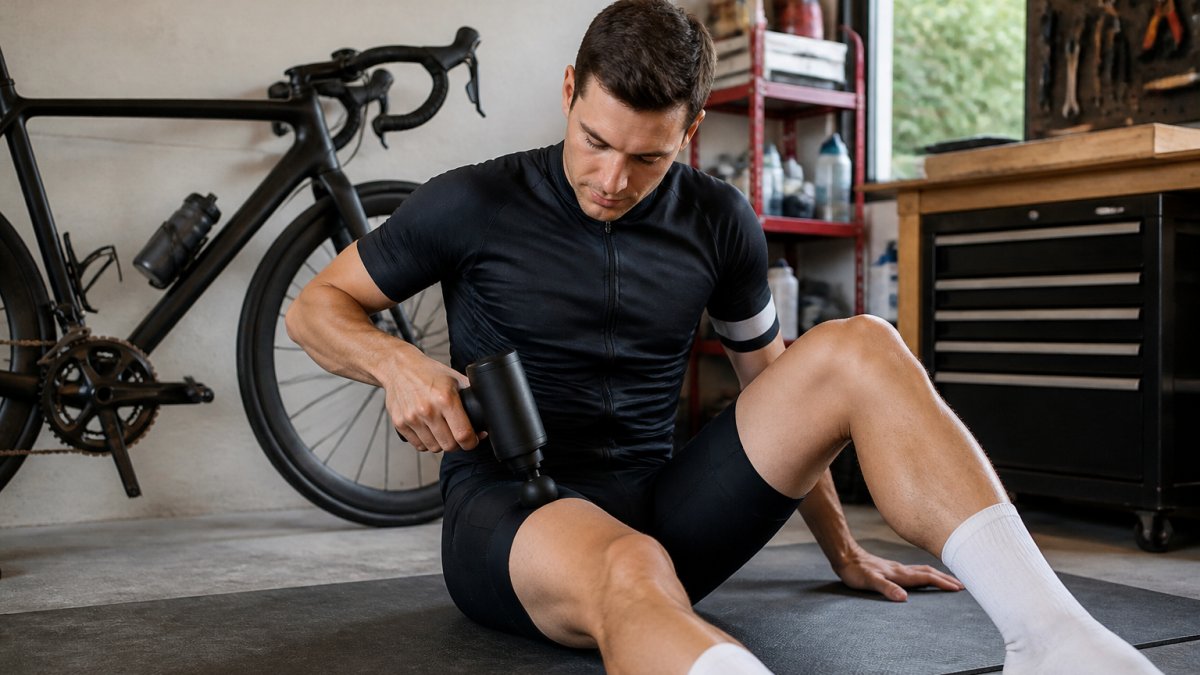
A practical sequence we recommend:
- Cool down first. Spin easy for five to ten minutes and rehydrate. Percussion on a body that is still at threshold heart rate is uncomfortable and pointless.
- Start proximal. Work the glutes and upper hamstring before the calf. Tension often starts higher up the chain than where you feel it.
- Keep the head moving. Two to three seconds per pass, back and forth along the muscle belly. Never hold still on one point.
- Stay off bone and joints. Avoid the kneecap, the shin bone, the spine and the front of the neck. The 2026 New Mini listing puts it plainly: avoid direct bone contact, and stop if discomfort occurs.
- Use low speed for flushing, higher for knots. If you find yourself pressing hard to feel anything, the speed is too low or the head is wrong.
- Ten minutes per area, maximum. The 10-minute auto shut-off on the 11-head model exists for a reason.
Timing matters less than consistency. A short session after every ride beats one long session on Sunday. If you want to compare approaches before committing, our breakdown of massage gun versus foam roller for mobility covers where each tool earns its place in a cyclist's routine.
Massage Gun for Quads and Calves: Where to Aim
Aim for the muscle belly, not the edges. On the quadriceps, that means the large mass on the front and outer thigh, staying clear of the kneecap and the bony ridge of the shin.
The quadriceps respond well to a flat or ball head on a medium setting, moved in long strokes from just above the knee toward the hip.
Two safety notes we will not soften. Do not use percussion over a swollen, hot or bruised area, and do not use it on a suspected strain or tear before a clinician has looked at it. If you have a diagnosed injury or a circulatory condition, clear the tool with your physiotherapist first.
That is also where the rest of a recovery system matters. A gun handles localized tension; mobility work and red light therapy address the broader picture. Vitalyns builds gear across five collections for exactly that reason: recovery is a routine, not a single device.
Most cyclists treat recovery as the thing they do when training is finished. Flip that: the riders who hold form through a long season are the ones who treat the twenty minutes after a ride as part of the session.
Frequently Asked Questions
Are massage guns good for cyclists?
Percussion therapy gives cyclists a way to work on muscle tension in the quads, calves, hamstrings and glutes without booking a session. Riders use a massage gun for cyclists after long or hard efforts to ease soreness and loosen tight tissue before the next session. It is a recovery tool, not a treatment for injury, so pair it with sleep, food and a sensible training load. If a muscle is painful to touch or swollen, skip percussion and get it checked.
How should cyclists use a massage gun after a ride?
Wait until you have cooled down and had water, then work through the muscles that did the most work. Glide the head slowly over each area for 30 to 60 seconds, keeping the pressure comfortable rather than painful. Cover quads, calves, hamstrings and glutes, then finish with hip flexors. A full routine takes 5 to 10 minutes. Start on a low speed and only increase once the muscle warms up and stops guarding.
Are mini massage guns powerful enough for cyclists?
For most riders, yes. A mini massage gun for cyclists is built around portability, so you can carry it in a kit bag or backpack and use it after a commute or a gym session. It will not match a full-size unit on stall force, so it suits surface-level tension and warm-ups more than deep work on dense quads. Riders with heavy training loads often keep a full-size gun at home and a mini for travel.
Which massage gun attachments are best for cycling recovery?
A round ball head covers large areas like quads and glutes, while a flat head works well along the calves and hamstrings where you want even pressure. A bullet or cone head suits narrow spots around the hip flexors and the tissue beside the shin, but keep it off bone. If your gun includes heat and cold heads, cold suits a hot, angry muscle after a hard effort and heat works better before a ride when tissue feels stiff.
Can you use a massage gun before cycling?
Yes, at a low speed and for a short time. Two to three minutes on the quads, calves and glutes can wake up tissue that feels tight from a previous day, and it works well as part of a warm-up rather than a replacement for pedalling easy. Keep the intensity gentle and avoid deep work right before a race or hard interval session, because heavy percussion can leave a muscle feeling flat for a while.
