


What Is the Best Massage Gun for CrossFit Athletes?

Last Updated: October 28, 2026
Quick Summary
The best massage gun for CrossFit athletes depends on your training scenario: the 11-Head Percussion Pistol ($30.28) suits deep-tissue work with its 8 mm amplitude and up to 3,200 percussions per minute, while the Mini Portable Gun ($5.49) fits travel and daily sessions. Match the massage gun to how often you train, whether you travel, and which muscle groups give you the most trouble.
- The 11-Head Percussion Pistol has a 1500 mAh battery with approximately 45 minutes of use per charge.
- Cap total massage gun time at about 2 minutes per muscle group after a workout.
- Cool down with 3 to 5 minutes of easy walking or rowing before using the gun.
- Use the fork attachment along the paraspinals so you avoid pressing on bone.
- The Heat & Cold Gun costs $26.97 and runs from 2400 to 3200 RPM across six speeds.
Table of Contents
- Why CrossFit Athletes Need a Different Kind of Massage Gun
- Quick Comparison: Vitalyns Massage Guns for CrossFit
- What Makes the Best Massage Gun for Athletes
- Top Picks by Training Scenario
- Choosing a Massage Gun for Post-Workout Recovery
- How to Use a Massage Gun After a Workout
- Massage Gun Attachments for Muscle Groups
- Safety, Contraindications, and When to See a Professional
- Frequently Asked Questions
Why CrossFit Athletes Need a Different Kind of Massage Gun
CrossFit is a different animal, and the best massage gun for CrossFit athletes reflects that. A typical WOD stacks high-rep Olympic lifting, gymnastics, and metabolic conditioning into one 20-minute window, so your quads, lats, and shoulders take repeated eccentric load that leaves dense muscle tissue tight for days. At Vitalyns, our recovery and mobility gear is designed to help you reset your body, improve mobility, and support muscle recovery.
When choosing a massage gun, consider its listed features and whether they suit your preferences.
The Muscle Groups CrossFit Punishes Most
- Quadriceps and glutes after high-volume squat cleans and wall balls
- Lats and mid-back from pull-ups, toes-to-bar, and rowing
- Shoulders and traps after overhead presses and handstand work
- Calves and Achilles from double-unders and box jumps
These are muscle groups athletes may focus on after training.
Quick Comparison: Vitalyns Massage Guns for CrossFit
Here's the short version before we break each pick down by scenario.
| Model | Price | Amplitude / Speed | Best For | Battery |
|---|---|---|---|---|
| 11-Head Percussion Pistol | $30.28 | 8 mm, up to 3,200 ppm, 99 settings | Deep-tissue work | 1500 mAh, ~45 min |
| Mini Portable Gun | $5.49 | 6 speed modes, ultra-quiet | Travel and daily sessions | USB rechargeable |
| 6-Head Massage Gun | $40.43 | Six heads, wider coverage | Broad coverage | Rechargeable |
| Heat & Cold Gun | $26.97 | 2400-3200 RPM, 6 speeds | Soreness and circulation | Up to 6 hours |
| 19-Mode Portable Gun | $34.23 | 19 modes, 4 speeds, IPX7 | Versatility | Rechargeable |
What Makes the Best Massage Gun for Athletes
When choosing a massage gun, consider the product specifications and features that matter to you.
Amplitude, Stall Force, and Percussions Per Minute
Amplitude is how far the head travels per stroke. The 11-head percussion pistol has an 8 mm amplitude.
Stall force is the pressure the motor withstands before it slows.
Percussions per minute sets the pace.
Stall resistance under load tells you more about real-world performance than the headline RPM figure. For a deeper look, see our best massage gun for deep tissue review.
Top Picks by Training Scenario
No single gun wins every scenario. Here's how we'd match each Vitalyns model to how you actually train.
Best for Deep-Tissue Work: 11-Head Percussion Pistol
The 24W motor drives up to 3,200 percussions per minute with an 8 mm amplitude, and 99 speed settings are listed for this product.
The product listing specifies 11 interchangeable heads, a 10-minute auto shut-off, and a 1500 mAh battery with approximately 45 minutes of use on a full charge.
Skip if: you want something that fits in a jacket pocket.
Best for Travel and Multiple Daily Sessions: Mini Portable Gun
The product listing describes this mini as smaller than a touchscreen phone and specifies six speed modes and USB recharging.
Check the full specs through our 2026 mini portable massage gun listing.

Skip if: you need maximum depth on large muscle groups.
Best for Broad Coverage: 6-Head Massage Gun
The product listing describes six heads working together to disperse vibrations across a larger coverage area.
Portable Massage Gun 19 Mode 4 Speed Personal Handheld Vibrating Massager Deep →
See the 6-head massage gun product page for the details.

Skip if: you want pinpoint work on a single knot.
Choosing a Massage Gun for Post-Workout Recovery
Match the tool to your recovery routine, not the other way around. A gun that sits in a drawer because it's awkward to carry helps nobody.
We'd weigh four things: how often you train, whether you travel, which muscle groups give you the most trouble, and your budget. If you're building a full recovery kit for the road, our recovery gear for frequent travelers guide covers the wider setup.
Two picks deserve mention here. The Heat & Cold Gun ($26.97) has six speed settings from 2400 to 3200 RPM and six interchangeable heads, including heat and cold options. The 19-Mode Portable Gun ($34.23) has 19 vibrating modes, four speeds, and an LCD display.
How to Use a Massage Gun After a Workout
Most massage-gun guides tell you to glide for 30 to 60 seconds and call it a day, which is not enough for a CrossFit athlete stacking squat cleans, pull-ups, and double-unders into the same week. The protocol below covers when to use the gun, how hard to press, how long to stay on one area, and how often to repeat it.
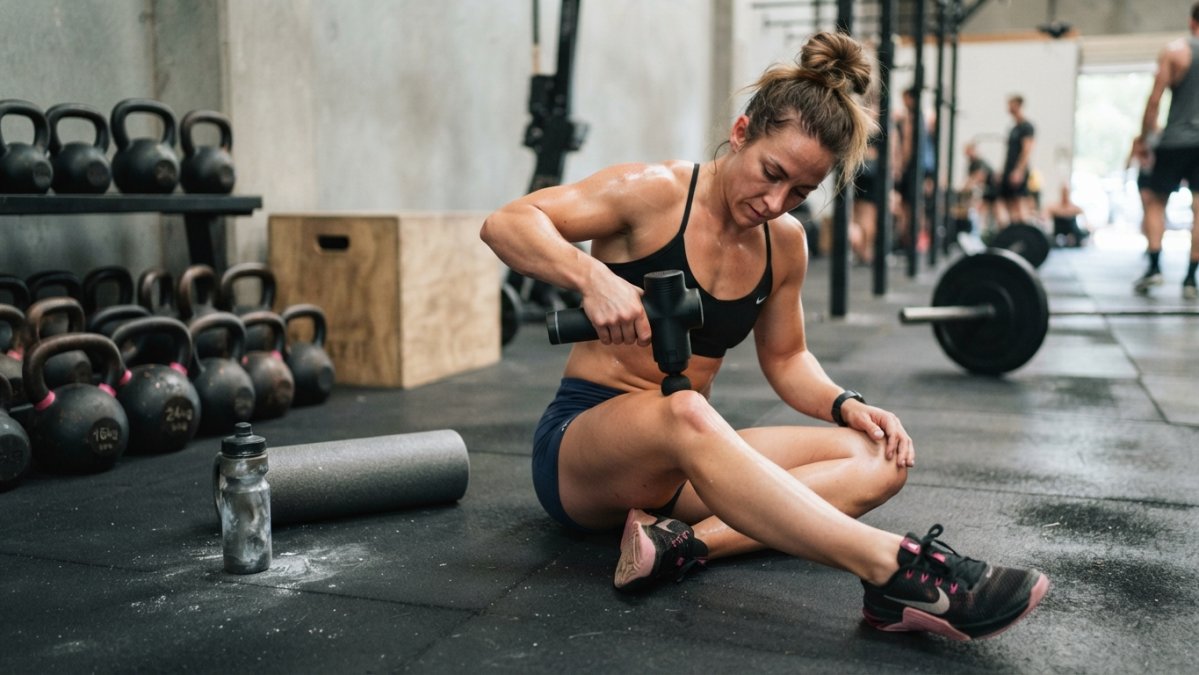
Post-Workout Protocol
- Cool down first. Walk or row easy for 3 to 5 minutes before you reach for the gun. Jumping straight from a metcon to percussion on a still-elevated heart rate is uncomfortable and unnecessary.
- Start at the lowest speed and glide over the whole muscle belly for 20 to 30 seconds. This is a tissue-check pass, not treatment.
- Increase to a moderate speed and work the muscle in slow passes for 60 to 90 seconds. Keep the head moving; do not park it on one spot.
- Cap total time per muscle group at about 2 minutes. Returns diminish past that point, and extended pressure on one area can leave you sore the next day.
- Work muscle bellies, not joints or bone. Stay off the knee, elbow, spine, and shin bone.
- Finish with range-of-motion work, a few air squats, shoulder circles, or hip openers, so the tissue you just worked moves through a full arc.
Warm-Up Protocol
Do not use a massage gun as a substitute for a proper warm-up. Percussion does not raise core temperature or prepare the nervous system for heavy lifts. It is a supplement to movement prep, not a replacement.
Frequency Across a Training Week
Treat 2 minutes per muscle group as a ceiling, not a target. Consistency across the week matters more than duration in any single session.
Pressure and Speed by Goal
- Warm-up primer: low speed, light pressure, 20-30 seconds per group.
- Post-WOD soreness: moderate speed, moderate pressure, 60-90 seconds per group.
- Stubborn knot or trigger point: moderate speed with a bullet or fork head, 30-45 seconds on the spot, then move on.
- Rest-day maintenance: lower speed, longer passes, full muscle coverage.
Cautions Against Overuse
Percussion is a temporary sensory input, not a structural fix. Aggressive daily use on the same area can leave tissue bruised or irritated; if you notice lingering tenderness, visible bruising, or numbness, back off for a few days. If soreness persists beyond a few days or changes how you move, see a professional rather than reach for the gun again.
Massage Gun Attachments for Muscle Groups
Attachments change how pressure is delivered, and for CrossFit athletes the right head depends on the movement pattern that left you sore, not just the muscle group. A fork head on a loaded quad wastes time; a bullet head on a broad glute is uncomfortable. Here's how to match heads to the movements CrossFit punishes most.
Match the Head to the Movement
- Squat cleans, wall balls, thrusters (quads and glutes): start with the foam ball or flat head. These large muscle bellies tolerate broad contact, the foam ball spreads pressure across the quad without digging in, and the flat head works well on the glute. Save the bullet head for a specific trigger point.
- Pull-ups, toes-to-bar, rowing (lats and mid-back): use the flat head for the lats, then switch to the fork attachment along the paraspinals. The fork straddles the spine so you can work the erectors without pressing on bone.
- Overhead presses, handstand work (shoulders and traps): the flat head or foam ball works the deltoid; the bullet head is useful for a tight trap trigger point, but keep pressure light around the shoulder joint.
- Double-unders, box jumps (calves and Achilles): use the bullet head on the calf muscle belly, not on the Achilles tendon itself. The foam ball is a safer choice for broad calf work.
- Kipping and gymnastics volume (forearms and grip): a small bullet or flat head on the forearm flexors and extensors, kept at low speed, helps after high-rep pull-up or bar muscle-up sessions.
Attachment Reference
- Foam ball: broad, cushioned contact for quads, glutes, and calves.
- Flat head: general-purpose work across back, shoulders, and larger muscle groups.
- Fork: straddles the spine for paraspinal work without pressing on bone.
- Bullet: pinpoint pressure for trigger points in calves, traps, and forearms.
- Heated attachment: adds warmth to stiff, cold tissue before deeper work, useful on cold mornings or before a heavy squat session.
If you want to expand your set, you can browse silicone massage gun attachments designed for fascia work. For most CrossFit athletes, the foam ball, flat head, and fork cover 90 percent of post-WOD needs.
Safety, Contraindications, and When to See a Professional
General guidance from the American College of Sports Medicine supports massage as part of recovery, but it is not a substitute for medical assessment. For broader context on percussive devices, the Cleveland Clinic overview of massage guns is a useful plain-language summary.
Vitalyns offers five distinct collections of recovery and mobility gear, including massage guns and red light therapy, designed to help you reset your body, improve mobility, and support muscle recovery. EXPLORE NOW.
Frequently Asked Questions
Should I use a massage gun after a CrossFit workout?
Vitalyns offers massage guns as part of its recovery and mobility gear.
What should CrossFit athletes look for in a massage gun?
The 11-head percussion pistol, for example, has a 24W motor, up to 3,200 percussions per minute, 99 speed settings, and an 8 mm amplitude.
Which massage gun attachment is best for large muscle groups?
The catalog lists a massage gun set with 16 heads.
How long should you use a massage gun on sore muscles?
The 11-head percussion pistol listing specifies a 10-minute auto shut-off.
Is it safe to use a massage gun before a workout?
The product catalog does not provide pre-workout use instructions.
