


Best Recovery Gear for Frequent Travelers in 2026

Table of Contents
- Why Frequent Travelers Need a Recovery Kit That Fits a Carry-On
- Quick Comparison: Best Recovery Gear for Frequent Travelers
- What to Look For Before You Buy Recovery Gear
- Travel Massage Gun: Percussion Relief That Packs Flat
- Compact Foam Roller for Travel: Rolling Out Soreness in a Hotel Room
- Massage Ball for Travel: The Smallest Tool in Your Bag
- Building a Recovery Kit for Travelers: Scenarios, Budget and Packing
- Frequently Asked Questions
Last Updated: October 16, 2026
Why Frequent Travelers Need a Recovery Kit That Fits a Carry-On
The best recovery gear for frequent travelers is compact, battery-powered, and built to survive being thrown into an overhead bin. That definition sounds obvious, but it rules out most of what gets sold as recovery equipment.
Think about what a normal travel week does to a body. You sit for hours in a pressurized cabin with your hips flexed. You sleep in a different bed. You eat at different times. You train in a hotel gym with whatever equipment happens to be there, or you skip training entirely and feel worse for it. By Thursday, your calves are tight, your lower back is cranky, and your shoulders sit somewhere near your ears.
This guide from Vitalyns covers the tools that actually earn their space in a carry-on, what to check before you buy, and how to build a kit around the way you travel. Below, we break down five categories of gear, what each one costs, and where each one falls short.
The core argument here is simple: travel recovery is a packing problem before it is a training problem. If a tool does not fit, does not charge, or does not survive transit, it does not matter how well it works at home.
Quick Comparison: Best Recovery Gear for Frequent Travelers
Every item below is a one-time purchase with no subscription, which matters when you are already paying for flights and hotel wifi. Prices are current as of October 2026.
| Tool | Price | Weight / Size | Best For |
|---|---|---|---|
| Portable Massage Gun (19 mode, 4 speed) | $34.23 | 182 g, 19 x 9.6 x 4.5 cm | Deep tissue relief anywhere |
| Mini Triangular Fascia Gun | $32.89 | Compact triangular body | Shoulder and neck tension |
| Mini Rolling Percussive Massager | $35.21 | 1.4 kg, multi-grip handle | Rolling out large muscle groups |
| Compression Leg Sleeve (full length) | $5.82 | Sizes S to 3XL | Knee and calf support in flight |
| Calf Compression Sleeve | $5.36 | Sizes S, M, L | Circulation on long-haul flights |
| Gel Ice Sleeve | $21.59 | Fits elbow, knee, ankle | Swelling and acute soreness |
| Foam Roller (45 cm or 33 cm) | $15.89 | 45 x 13 cm | Post-workout recovery at the hotel |
| Resistance Bands (5 levels) | $1.62 | 600 mm loop, mesh bag | Warm-up and mobility work |
| Stretch Strap | $4.56 | 60 x 11 cm | Shoulders, back, hip opening |
The pattern is hard to miss. The tools that cost the least are the ones that need no battery and no charging cable, and they are also the ones that never get flagged at security.

What to Look For Before You Buy Recovery Gear
Three factors decide whether a recovery tool works on the road: whether it clears carry-on rules, whether it holds a charge across a multi-day trip, and whether it survives being compressed in a bag.
Weight, Size and Carry-On Compliance
Most airlines restrict carry-on bags to roughly 55 x 40 x 20 cm and around 7 to 10 kg, though exact limits vary by carrier and fare class, so check your airline's published allowance before you fly. A 1.4 kg massager eats a meaningful share of a tight weight budget.
The practical test is simpler than the rulebook. Lay the tool next to your folded clothes. If it takes up more space than a pair of shoes, it stays home.
Battery-powered massage guns are allowed in carry-on baggage because they contain lithium batteries, but they generally cannot go in checked luggage. That single rule reshapes how you pack: your percussion tools travel with you in the cabin, and your rollers and sleeves can go anywhere.
Battery, Charging and Durability
Rechargeable tools should use USB-C or standard USB charging so you can top them up from a laptop, a power bank, or a hotel USB port. Proprietary chargers are a liability on the road, because a lost cable means a dead tool for the rest of the trip.
Look for stated battery life in hours, not vague claims about "long-lasting performance." A tool that runs three to four hours on a charge will cover a week of short daily sessions.
Travel Massage Gun: Percussion Relief That Packs Flat
A travel massage gun is the highest-output tool you can reasonably carry, and it is the one most travelers reach for first. Percussion devices deliver rapid pulses into muscle tissue, which many athletes find helps relieve tightness and post-workout soreness.
Our pick for most travelers is the Portable Massage Gun 19 Mode 4 Speed at $34.23. It weighs 182 g, runs on a rechargeable battery, and offers 19 vibration modes across 4 speeds with a 9000 RPM motor. The LCD display shows your current mode and remaining power, so you know when to charge it rather than finding out mid-session.
Two details set it apart for travel. It carries an IPX7 waterproof rating, and the silicone head is soft against skin.
Where it falls short: at 182 g it is light, but it is still a device with a battery, so it needs a spot in your personal item rather than a checked bag. If you want something even smaller, the Mini Triangular Fascia Gun at $32.89 uses a triangular body shape that reaches shoulder and neck angles more easily.

For heavier rolling work across the back and legs, the Mini Rolling Percussive Massager at $35.21 combines a roller head with percussive movement. Its 1800 mAh battery runs up to four hours, and the multi-grip handle lets you change hand position as you work down a muscle. The tradeoff is weight: 1.4 kg is a real commitment in a carry-on.

Compact Foam Roller for Travel: Rolling Out Soreness in a Hotel Room
A compact foam roller for travel solves the problem no battery-powered tool can: sustained pressure across a broad area. Rolling applies your own body weight to the muscle, which is why it works so well for the quads, IT band, and upper back after a long flight or a hard session.
Portable Massage Gun 19 Mode 4 Speed Personal Handheld Vibrating Massager Deep →
The 45 cm Yoga Foam Roller at $15.89 is built from EVA foam and comes in two lengths: 45 x 13 cm and 33 x 13 cm.
Where it falls short: a hollow or firm roller takes up real volume, and it cannot be compressed. If your bag is already tight, a massage ball does much of the same job in a fraction of the space.
Massage Ball for Travel: The Smallest Tool in Your Bag
A massage ball for travel is the highest value-per-gram item in any recovery kit. It weighs almost nothing, needs no charging, and reaches spots a roller cannot, including the glutes, the arch of the foot, and the tissue around the shoulder blade.
You can use any firm ball for this, but a purpose-built option gives you consistent density and grip. Pair it with the Stretch Strap at $4.56 for shoulder and back work. The strap measures 60 x 11 cm and offers resistance from 15 to 90 lbs.
Where it falls short: a ball only works if you can get on the floor. In a tight hotel room or an airport gate area, that is not always possible, which is exactly why the strap earns its place. It works standing up.
Resistance bands round out the low-tech layer. The Resistance Band Set starts at $1.62 and packs into a mesh bag small enough for a jacket pocket. Five resistance levels, from extra light to extra heavy, cover warm-ups and activation work without any equipment in the room.
Building a Recovery Kit for Travelers: Scenarios, Budget and Packing
The right recovery kit for travelers depends on trip length and how much you plan to train, not on how much gear you can afford. Here is how we would build it for three common scenarios.
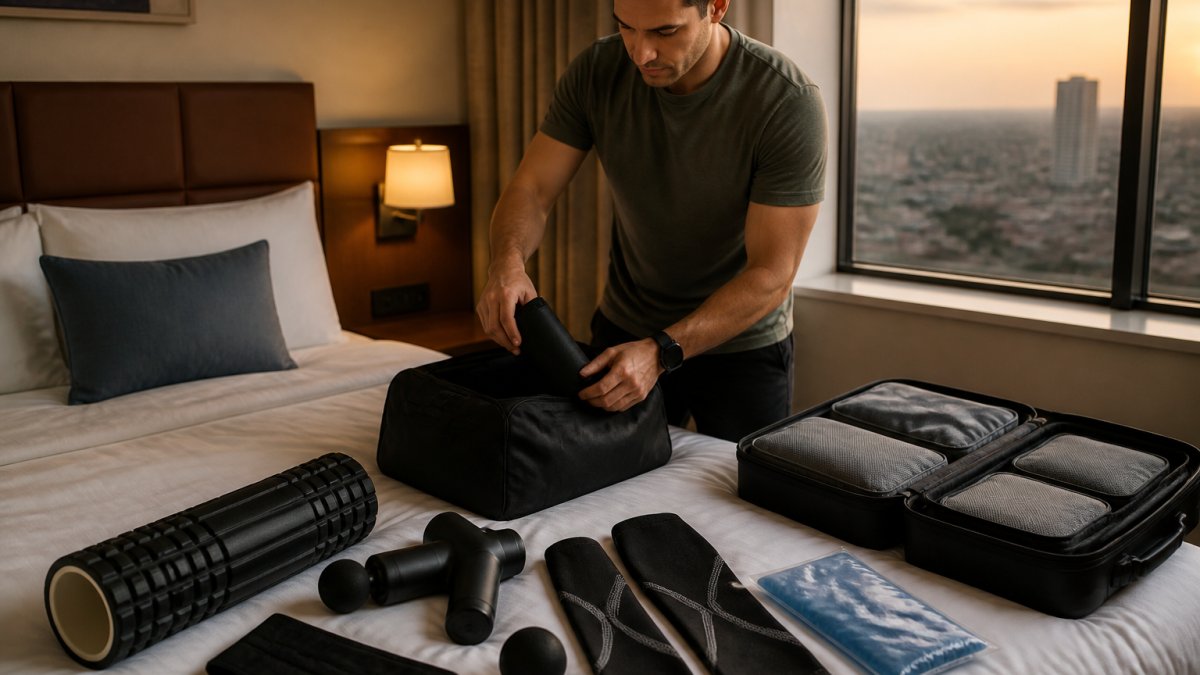
Scenario 1: Two-day business trip, no training planned. Pack the compression sleeves and the massage ball. The Calf Compression Sleeve at $5.36 uses gradient fabric to support blood flow in the legs, and it is designed for exactly the situation of sitting still for hours. Total kit cost: under $10.
Scenario 2: Five-day trip with hotel gym sessions. Add the massage gun and the resistance bands. The gun handles post-workout soreness, and the bands cover warm-up and mobility work when the gym is crowded. Total kit cost: around $36.
Scenario 3: Training camp or competition travel. Bring the full kit: rolling massager, massage gun, foam roller, bands, strap, and the Gel Ice Sleeve at $21.59.
The packing checklist we actually use:
- Massage gun in your personal item, never checked
- Charging cable in the same pouch as the gun
- Foam roller strapped to the outside of the bag or left home for short trips
- Massage ball in a shoe, since it takes up otherwise wasted space
- Compression sleeves worn on the flight, not packed
- Resistance bands in the laptop compartment
- Gel sleeve frozen only if your hotel has a freezer, otherwise packed flat
On budget and durability: every tool listed here is a one-time purchase, and the cheapest items are the ones that last longest because they have no electronics to fail. If you are buying your first kit, start with the sleeves, the ball, and the bands.
Travel throws your training rhythm out of alignment, and the tools you leave at home are the ones you end up wishing you had packed.
Frequently Asked Questions
What recovery gear should frequent travelers pack?
Start with three items: a handheld percussive massager, a short foam roller and a small massage ball. That trio covers most muscle groups, weighs little and fits in a carry-on. Add compression sleeves if you sit for long stretches, and a reusable gel ice sleeve for joints that swell after training. Build the kit around the sessions you actually do on the road, not the ones you plan at home.
Are massage guns allowed in carry-on luggage?
Battery-powered massage guns are treated like other lithium-battery electronics, so they generally travel in carry-on rather than checked bags, where spare batteries are restricted. Check your airline's battery rules before you fly and confirm the watt-hour rating of the device. The Portable Massage Gun from Vitalyns weighs 182g and measures 19 x 9.6 x 4.5cm, so it slots into a carry-on with room to spare. Pack it in your recovery kit so it is easy to reach at security.
How can I relieve muscle soreness after a long flight?
Move before you sit still. Walk the aisle when you can, then use a massage ball or percussive massager on calves, hamstrings and lower back once you reach the hotel. Compression sleeves support circulation during the flight itself, which matters most on long-haul routes. A short foam roller session on your back and legs helps reset tension from hours in a seat. Keep the routine to 10 to 15 minutes so it stays realistic after a travel day.
Are massage balls or foam rollers better for travel?
They solve different problems, so most travelers carry both. A massage ball is smaller and heavier per square centimetre, which makes it better for knots in the glutes, shoulders and feet. A compact foam roller for travel covers broad areas like quads, hamstrings and the back in less time. If you can only take one, take the ball for precision and use your hands and a wall for the rest. If you have space, the 45cm foam roller from Vitalyns is light and rolls into a kit.
How do you build a travel recovery kit on a budget?
Buy in the order you will use it. A massage ball and resistance bands cost the least and cover warm-up, mobility and trigger point work. Add compression sleeves next, then a percussive massager, then a foam roller. Vitalyns prices make this easy to stage: resistance bands start at 1.62, a calf compression sleeve at 5.36 and a full-length leg sleeve at 5.82, while the Mini Rolling Percussive Massager is 35.21. Spend on the tools you will use daily and skip the ones that only look good in a bag.