


How to Manage DOMS After Heavy Lifting: A Recovery Plan

Table of Contents
- What DOMS Is and Why Heavy Lifting Sets It Off
- How Long Does DOMS Last After Heavy Lifting?
- Can You Work Out With DOMS? How to Adjust Your Next Session
- Active Recovery for Sore Muscles: Movement That Helps
- Ice or Heat for Sore Muscles: Which to Use and When
- Tools That Support Recovery: Foam Rolling, Massage Guns, and Hydration
- When Soreness Is a Sign of Injury, Not DOMS
- How to Prevent DOMS Next Time: Warm-Ups, Progression, and Returns From a Break
- Frequently Asked Questions
Last Updated: October 21, 2026
What DOMS Is and Why Heavy Lifting Sets It Off
Delayed-onset muscle soreness is the ache and stiffness you feel in a muscle 24 to 72 hours after hard training. It is not damage from a single bad rep.
At Vitalyns, we build gear for the hours after training, so we spend a lot of time thinking about how to manage DOMS in this window. Here is the short version: how to manage DOMS after heavy lifting comes down to three things.
Why Soreness Arrives a Day or Two Later
Soreness has a delay because the muscle is repairing, not because it is still being damaged. The process takes time.
- Micro-tears form in the muscle fibers during the session
- The body sends fluid and repair cells to the area
- Swelling and stiffness peak a day or two later
- The ache fades as the repair finishes
This is why you can finish a heavy squat session feeling fine and struggle to sit down two days later. The NHS guidance on muscle soreness and strain draws a useful line between ordinary soreness and a strain, which we come back to later.
How Long Does DOMS Last After Heavy Lifting?
Most soreness peaks between 24 and 48 hours and clears within three to five days. The exact timeline depends on how new the stimulus was, how heavy you went, and how well you sleep and eat.
A first session back after a break will hit harder than the same session three weeks into a block. That is normal, and it is not a reason to skip training.
A Practical Recovery Timeline for the Days After a Session
Use this as a rough map, not a rulebook. Adjust it to how you actually feel.
| Day | What You'll Feel | What to Do |
|---|---|---|
| Day 0 (session day) | Warm, tired, no soreness yet | Cool-down, fluids, protein, sleep |
| Day 1 | Stiffness builds, ache starts | Light movement, easy walk, hydrate |
| Day 2 | Peak soreness and tightness | Active recovery, foam rolling, gentle stretching |
| Day 3 | Soreness eases, mobility returns | Light training on other muscle groups |
| Day 4-5 | Near normal | Return to normal loading if pain is gone |
If soreness is still sharp on day five, treat it as a warning sign rather than a slow recovery.
Can You Work Out With DOMS? How to Adjust Your Next Session
Yes, you can train with soreness, as long as the muscle is sore rather than injured. The key is to change the session, not cancel it.
A common mistake is going straight back to the same heavy load on the same muscle group.
Here is how we would adjust the next session:
- Train a different muscle group if the sore one is still tender
- Drop the load and keep the reps clean if you train the same area
- Swap heavy compounds for lighter, controlled work
- Cut total sets by roughly a third
- Stop any set that turns soreness into sharp pain
Light movement also helps blood flow reach the muscle. That is the whole point of active recovery, which we cover next.
Active Recovery for Sore Muscles: Movement That Helps
Active recovery means easy movement that raises blood flow without adding real training stress. It works because it helps the muscle get the fluid and nutrients it needs to repair.
Good options are simple and low impact:
- A 20 to 30 minute walk
- Easy cycling on a flat route
- Swimming or pool walking
- Bodyweight mobility drills
- Gentle yoga flows
Keep the effort easy. If you finish more tired than you started, you pushed too hard. The goal is circulation, not a second workout.
Ice or Heat for Sore Muscles: Which to Use and When
Ice is best right after a session or for a fresh, swollen area. Heat is better once the soreness has settled in and the muscle feels tight and stiff.
Here is the practical split:
- Ice: first 24 hours, or after a knock or swelling
- Heat: day two onward, when the muscle feels tight and stiff
- Neither: if the area is hot, red, and swollen, get it checked
Many lifters overuse ice. Cold slows blood flow, and blood flow is what carries repair. Use it briefly for swelling, then switch to heat and movement.
Tools That Support Recovery: Foam Rolling, Massage Guns, and Hydration
Recovery tools help you work through tight, sore tissue between sessions.
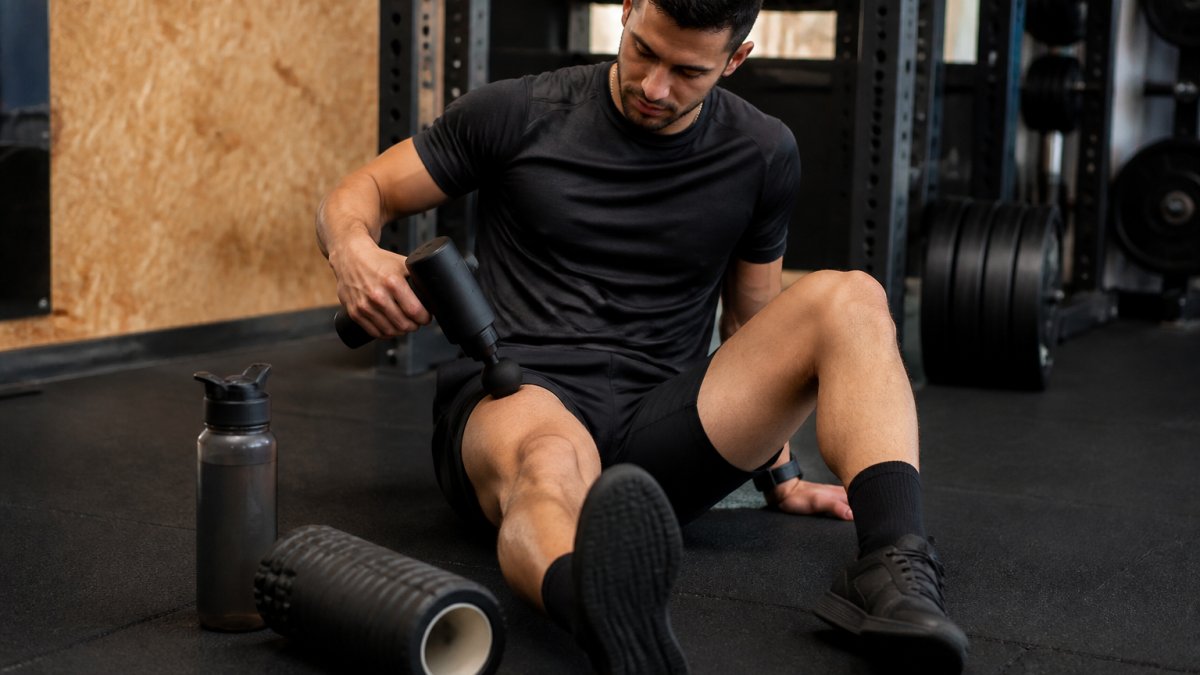
Our American College of Sports Medicine guidance on recovery reading is that these tools are supportive, not magic.
Portable Massage Gun 19 Mode 4 Speed Personal Handheld Vibrating Massager Deep →
Foam rolling works well on large muscle groups. Roll slowly over the sore area for 30 to 60 seconds and skip anything that feels sharp.
Massage guns are handy for hard-to-reach spots like the calves and upper back. Our Portable Massage Gun 19 Mode 4 Speed Personal Handheld Vibrating Massager offers 19 modes and 4 speeds, with a waterproof, cordless build that travels well. For deeper work with temperature options, our Deep Tissue Massage Gun with Heat Cold 6 Speeds runs at 2400 to 3200 RPM with six interchangeable heads.

For rolling, the 45cm Yoga foam roller covers the quads, glutes, and back in a few passes. The Hexagonal Yoga Roller uses hexagonal nodes and a 35° shore hardness for firmer pressure.


Hydration matters just as much. Drink water through the day, and add electrolytes if you sweated heavily.
When Soreness Is a Sign of Injury, Not DOMS
Most post-lifting soreness is ordinary DOMS: dull, spread across the belly of the muscle, roughly symmetrical, and improving day by day. An injury behaves differently.
The tricky part is that both can show up in the same 48-hour window, so lifters often mistake a strain for bad DOMS and train through it. Use the comparison below to tell them apart.
| Feature | Typical DOMS | Injury or strain |
|---|---|---|
| Sensation | Dull ache, diffuse | Sharp, pinpoint, or tearing |
| Symmetry | Usually both sides | Often one side only |
| Response to light movement | Eases | Worsens or stays sharp |
| Strength | Mildly reduced, usable | Clear weakness or giving way |
| Swelling | Minimal, if any | Visible swelling or bruising |
| Trajectory | Peaks day 1-2, improves | Worsens over days |
Red Flags That Need Medical Attention
Stop training and seek advice from a qualified professional if you notice any of the following:
- Sharp pain in one small spot that does not ease with rest
- Visible swelling, bruising, or heat that grows over 24-48 hours
- A sudden pop or tear sensation during the lift, followed by weakness
- Loss of range of motion or the joint giving way
- Pain that keeps getting worse past day three instead of better
- Numbness, tingling, or weakness in the limb
That dark-urine point deserves emphasis. Rhabdomyolysis is rare but serious, and it is most often triggered by unaccustomed extreme effort, a first CrossFit class, a long dehydration-heavy session, or returning to heavy lifting after a long layoff. If you suspect it, do not wait to see if it settles.
If you are unsure, the safe default is to rest the area, keep moving gently, and reassess in 24 hours. A strain that gets a day of rest is a minor setback. A strain that gets trained through can become a multi-week layoff.
How to Prevent DOMS Next Time: Warm-Ups, Progression, and Returns From a Break
You cannot eliminate soreness, and you would not want to, it is part of how the muscle adapts. What you can do is keep it predictable and manageable instead of getting floored for four days after every session. The biggest lever is not a supplement or a tool. It is how you progress load and volume.
The Two Variables That Drive Soreness Most
DOMS is driven mainly by novelty and by eccentric (lowering) work. A muscle that has not seen a stimulus recently will be sore regardless of how heavy the weight is. That is why a first session back after a break can hurt more than a much heavier session three weeks into a block.
- Novelty: new exercises, new ranges of motion, new tempos
- Eccentric volume: slow lowering, high-rep sets, and exercises with a strong stretch under load (Romanian deadlifts, split squats, Nordic curls)
If you are adding either of those, add them gradually rather than all at once.
Practical Progression Rules
- Warm up with 5-10 minutes of easy movement plus lighter ramp-up sets of the first lift
- Increase load or volume by roughly 5-10% per week rather than jumping in one session
- When you introduce a new exercise, start with 2-3 sets at a moderate load before pushing it
- Keep training frequency steady, a muscle trained weekly stays more tolerant than one trained sporadically
- Cool down with easy movement and a brief stretch, mainly to feel better rather than to prevent soreness
- Protect sleep and protein intake on training days, since both support repair
Returning After a Training Break
The first week back is where most avoidable soreness happens. A common pattern is to return at the load you left off at and pay for it for five days. A better approach:
- Week one: about 60-70% of your previous working loads, focusing on form and range of motion
- Week two: build toward 80-85%, adding a set or two if soreness is manageable
- Week three: return to normal loading if recovery has been clean
Expect some soreness in week one regardless. The goal is to keep it in the "annoying but trainable" range rather than the "can't sit down" range.
For Experienced Lifters
Long-time lifters still get sore after a new movement, a big volume jump, or a return from time off. The difference is that they plan around it: they schedule unfamiliar work at the start of a lighter week, they keep easy movement in the days after, and they do not panic when day two feels rough.
You will not prevent every sore day. But by controlling novelty, eccentric volume, and how you return from a break, you can keep soreness in a range that does not derail your week.
Frequently Asked Questions
How long does DOMS usually last after heavy lifting?
Soreness typically appears 12 to 24 hours after a hard session, peaks around 24 to 72 hours, and fades within three to five days. The exact window depends on how novel the training was, how heavy the load, and how many sets you did. If soreness is still worsening past day three or lasts beyond a week, treat it as a signal to get it checked rather than pushing through.
Can you work out with DOMS, or should you rest completely?
You can train with DOMS if the soreness is mild and range of motion is close to normal. Reduce load and volume on the affected muscle groups, prioritize technique, and shift focus to areas that are not sore. Skip heavy eccentric work on the sore muscle for a day or two. If the muscle feels weak, swollen, or painful at rest, take the session off and use light movement instead.
Is ice or heat better for sore muscles?
Heat is usually the better choice for DOMS because it increases blood flow and helps the muscle feel looser before movement. Ice is more useful right after an acute injury or for numbing a specific painful spot, not as a routine soreness treatment. A common approach is heat before activity and light movement, then a warm bath or shower in the evening. Avoid prolonged icing of large muscle groups.
Does light exercise actually help relieve DOMS?
Light movement helps many lifters feel better because it increases blood flow and reduces stiffness, though it does not necessarily speed up muscle repair. Try 10 to 20 minutes of easy cycling, walking, or bodyweight movement at a conversational pace. Keep intensity low, avoid loaded eccentrics, and stop if pain increases. Pair it with hydration and a protein-containing meal to support recovery.