


Best Recovery Gear for Weightlifting 2026: Top Tools

Table of Contents
- Why Recovery Gear Matters for Weightlifting in 2026
- Quick Comparison: Best Recovery Gear for Weightlifting
- The Best Massage Gun for Weightlifters: Percussion Therapy Picks
- Foam Roller for Muscle Recovery: Self-Myofascial Release Tools
- Cold and Heat Therapy: Compression and Temperature Tools
- Therabody vs Hyperice Recovery Tools: What to Know Before You Buy
- Building a Weightlifting Recovery Routine with Your Gear
- Conclusion
- Frequently Asked Questions
Last Updated: October 19, 2026
Why Recovery Gear Matters for Weightlifting in 2026
Recovery gear is the equipment you use between sessions to reduce muscle soreness, restore range of motion, and manage training load. At Vitalyns, we build our whole catalogue around one idea: progress happens after the effort, not during it. That is why the best recovery gear for weightlifting in 2026 is judged by how consistently you use it, not by how many boxes it ticks.
Here is the uncomfortable truth most roundups skip. A massage gun will not fix a five-hour sleep debt. Compression boots will not out-train a calorie deficit. Gear is a multiplier on the basics, never a replacement for them.

Quick Comparison: Best Recovery Gear for Weightlifting
The table below maps each Vitalyns tool to the job it does best, so you can scan by need rather than by product name.
| Tool | Best For | Price |
|---|---|---|
| Portable Massage Gun, 19 modes | Travel and budget setups | $34.23 |
| Deep Tissue Massage Gun with Heat/Cold | Heavy compound lifters | $26.97 |
| Hexagonal EVA Foam Roller | Targeted fascia work | $5.43 |
| 45 cm EVA Foam Roller | Full-body rolling | $15.89 |
| Cold Recovery Circulating Device | Post-surgery and joint swelling | $65.24 |
| RecoveryTherm Cube | Hot and cold contrast work | $76.75 |
| Gel Ice Sleeve | Joint-specific icing | $21.59 |
| Calf Compression Sleeve | Shin and calf support | $5.36 |
| Rechargeable Leg Massager | Full-leg air compression | $87.25 |
Two things stand out. First, the entry point into real recovery gear is lower than most lifters assume. Second, the expensive items are not automatically the ones you need first.

The Best Massage Gun for Weightlifters: Percussion Therapy Picks
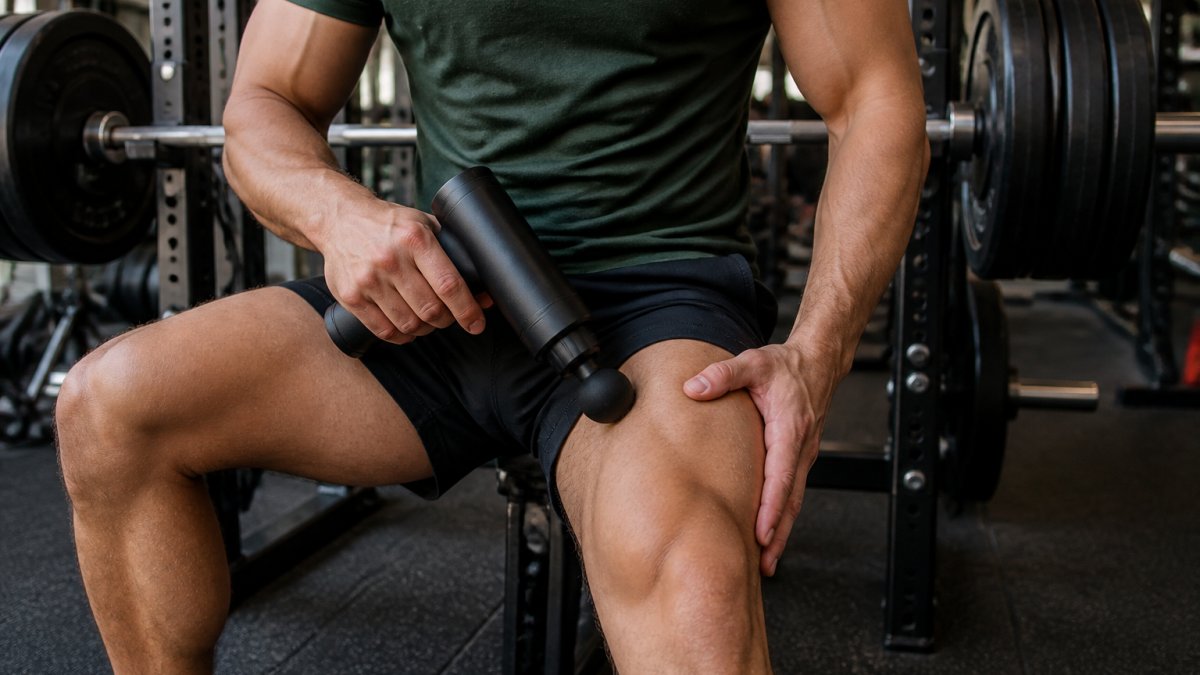
The best massage gun for weightlifters is the one you will actually carry to the gym and use for two minutes between sets, not the one with the longest feature list. Percussion therapy delivers rapid, targeted pulses into muscle tissue to reduce tension and support blood flow. For lifters, the practical value is pre-lift activation and post-lift tension release.
Portable Massage Gun with 19 Modes
Our most portable option weighs 182 grams and fits in a gym bag pocket. It runs 19 vibration modes across 4 speeds at 9000 RPM, with an LCD screen showing mode, speed, and battery level. The IPX7 rating means it can be fully submerged, which matters if you want to use it in a pool or bath after training.
Where it falls short: at 9000 RPM it is a tension-release tool, not a deep-tissue workhorse. For warm-ups, travel, and between-set work on smaller muscle groups, it holds up well.
Deep Tissue Massage Gun with Heat and Cold
This is the pick for lifters moving serious loads. Six speeds from 2400 to 3200 RPM give you enough range for gentle shoulder work and firm erector tension release. Six interchangeable heads include heat and cold attachments, so you get temperature contrast without a second device. The brushless motor runs quiet, and the battery is rated for up to 6 hours of use.
Foam Roller for Muscle Recovery: Self-Myofascial Release Tools
A foam roller for muscle recovery is a firm cylinder you use to apply sustained pressure to muscle and fascia, which is the connective tissue wrapping your muscles.
Our hexagonal roller is the one we recommend for lifters with specific trouble spots. At 9.5 cm diameter and 29.7 cm long, it fits under a lat, a glute, or a calf without slipping.
The 45 cm EVA roller is the general-purpose option. Longer surface area suits thoracic spine work and full-leg passes, and EVA foam is dense enough to last without going soft. If you are buying one roller, start here.
Cold and Heat Therapy: Compression and Temperature Tools
Cold therapy narrows blood vessels to reduce swelling and calm irritated tissue. Heat therapy does the opposite, increasing blood flow and loosening stiffness. Lifters need both, and the mistake is picking a favorite and using it for everything.
Cold Recovery Device with Compression Pad
This circulating ice water system is the most complete cold tool in our range. A 15-quart insulated bucket holds ice for up to 12 hours, and five flow speeds let you dial compression intensity from gentle to firm. The pump runs at 15 dB or less, quiet enough to sleep through. Six timer settings run from 10 to 60 minutes, plus a continuous mode and an alternating work-pause cycle.
The wrap fits knee, shoulder, arm, back, hip, leg, ankle, and hand. It ships with a protective isolation film for skin. For lifters managing post-surgical swelling or a chronically angry joint, this is a valuable tool.
RecoveryTherm Cube Hot Cold Therapy Machine
If you want one machine for both temperatures, the RecoveryTherm Cube covers it. Cold settings run 5, 10, and 15°C, heat runs 38, 42, and 47°C, and three flow rates control how aggressively the temperature reaches the pad. Three modes let you switch between hot and cold without swapping equipment.
One honest caveat: this unit is heavy, and shipping is quoted separately. It suits a fixed home recovery station.
Gel Ice Sleeve and Calf Compression Sleeve
The gel ice sleeve is the cheap, flexible option. It wraps 360 degrees around a knee, elbow, ankle, wrist, or calf, and works hot or cold: two hours in the freezer or one minute in the microwave. Polyester and gel construction keeps it soft when frozen, so it conforms instead of sitting like a brick.
Cold Recovery Device Ice Water Circulating System with Compression Pad →
The calf compression sleeve uses gradient elastic fabric to create a pressure differential that supports blood flow to the lower leg. It comes in S, M, and L covering calf circumferences from 26 to 46 cm. Lifters dealing with shin splints, calf cramps, or post-session swelling will get more out of this than out of another massage attachment.
Therabody vs Hyperice Recovery Tools: What to Know Before You Buy
The comparison of recovery tools from other brands dominates search results, and some brands have earned their reputation in professional sport. The real question is whether a device matches your training context, your travel schedule, and the specific tissue you are trying to treat.
Big-name percussion devices are built around high-amplitude motors and app ecosystems. That is genuinely useful for a competitive lifter with a structured recovery block.
Our position is simple. Buy for the job, not the logo. A $26.97 deep tissue gun with heat and cold heads covers many recovery scenarios for a home lifter. A $5.43 hexagonal roller handles glute and lat work. And a $65.24 circulating cold system offers unique benefits.
Building a Weightlifting Recovery Routine with Your Gear
A weightlifting recovery routine is the scheduled sequence of sleep, nutrition, mobility work, and tool-assisted treatment you repeat between sessions. The gear only performs inside that schedule. Here is the order we recommend, and the reasoning behind it.
- Before training (5 minutes): Portable massage gun on quads, glutes, and shoulders at low speed to wake up tissue. Add a heat head on any stiff joint.
- After training (10 minutes): Hexagonal roller on glutes, lats, and calves. Slow passes, 30 to 60 seconds per spot, breathing steadily.
- Evening of a heavy session (20 minutes): Leg massager or calf sleeve for circulation, especially after high-volume squat or deadlift work.
- Next morning: Cold Recovery Device on any joint that swelled, or the gel sleeve for a smaller area.
- Rest days: Foam roller for general mobility, plus a full-leg compression session if you sit at a desk.
Two rules are important. First, gear time should never eat into sleep time. Second, if soreness lasts beyond roughly 72 hours or worsens with each session, that may indicate a training load problem.

Conclusion
The hardest part of recovery is not buying gear. It is building a routine you repeat when motivation is low and the next session is already looming. Start with one tool that matches your biggest limitation, use it consistently for a month, then add the next.
Vitalyns builds a five-collection recovery system around exactly that progression, from portable percussion and foam rollers to circulating cold therapy and compression. Every piece is designed to help you reset your body, improve mobility, and support muscle recovery so you are ready for the next challenge.
American College of Sports Medicine position stands on exercise recovery
National Strength and Conditioning Association guidance on recovery methods
CDC resources on sleep and physical recovery
Frequently Asked Questions
Are massage guns effective for weightlifting recovery?
Massage guns use percussion therapy to deliver rapid pulses into muscle tissue, which can help reduce muscle tension and soreness after heavy lifting. They are most useful for large muscle groups like quads, glutes, and calves. Use a massage gun for 2-3 minutes per muscle group at a moderate speed. While they won't replace sleep and nutrition, they are a practical addition to a weightlifting recovery routine and can improve range of motion before training.
Is a foam roller or massage gun better after lifting?
Both tools serve different purposes in a recovery gear collection. A foam roller for muscle recovery covers broad areas and applies sustained pressure for self-myofascial release, making it ideal for large muscle groups like the back and IT band. A massage gun targets specific knots with concentrated percussion. Many weightlifters use a foam roller first for general tissue work, then a massage gun for stubborn trigger points. Combining both gives more complete coverage than either alone.
How long should you use a massage gun on a muscle?
Most guidelines suggest 2-3 minutes per muscle group at a low to moderate speed. Avoid staying on one spot for more than 30 seconds, and never use a massage gun directly on bones, joints, or the neck. For weightlifters dealing with delayed-onset muscle soreness, a short session after training and again the next day can help manage stiffness. If you have an injury, check with a physiotherapist before using percussion therapy on the affected area.
What recovery tools help improve mobility for weightlifters?
Mobility-focused recovery gear includes foam rollers, massage guns, resistance bands, and compression sleeves. Foam rollers address fascial tightness, massage guns release trigger points, and resistance bands support active stretching and warm-up drills. Compression sleeves on the calves can help with blood flow during and after sessions. A consistent weightlifting recovery routine that pairs these tools with sleep and hydration will do more for mobility than any single device.
How do Therabody and Hyperice recovery tools compare?
Other brands are established names in percussion therapy and compression, but some sit at premium price points. When comparing recovery tools, look at amplitude, battery life, and attachment variety. Vitalyns offers massage guns with 19 modes and heat-cold heads at lower prices, plus cold therapy machines and compression devices. The right choice depends on your budget and whether you want one premium device or a broader recovery gear setup.
Recovery is where the next PR is built, and it deserves the same structure you give your programming. Explore the Vitalyns recovery collections to find the tools that fit your training, then commit to one routine for the next four weeks. Move better, recover faster, perform stronger.