


Best Foam Roller for Tight Muscles: Top Picks for 2026

Table of Contents
- How to Choose the Best Foam Roller for Tight Muscles
- Top Foam Rollers for Tight Muscles Compared
- Benefits of Foam Rolling for Athletes
- How Long to Foam Roll Each Muscle Group
- Foam Roller vs Massage Gun for Recovery
- Safe Technique and Areas to Avoid
- What Foam Rolling Can and Cannot Do
- Frequently Asked Questions
Last Updated: October 10, 2026
How to Choose the Best Foam Roller for Tight Muscles
Finding the best foam roller for tight muscles comes down to three variables: firmness, texture, and length.

At Vitalyns, we build recovery gear around a simple idea: progress happens after effort, not during it.
Here is the part most guides get wrong. They rank rollers by how aggressive they feel. Tender tissue usually responds better to moderate, broad pressure than to a hard, narrow spike.
American Council on Exercise guide to foam rolling
Firmness and Density: Why Soft Beats Hard on Tender Spots
Firmness decides how much pressure reaches the tissue. A high-density foam roller transfers nearly all your body weight into a small contact patch. That feels productive.
On genuinely tender areas, a softer or moderate roller lets you stay on the tissue long enough to get a response.
A common mistake is buying the hardest roller available as a beginner. If you are new to rolling, start moderate and move firmer only when the area stops complaining.
Texture and Surface Design: Smooth vs Textured Rollers
Texture changes how pressure is distributed. Smooth rollers spread load across a wide, even band. Textured rollers, with grid patterns or raised nodes, concentrate force into smaller points.
That makes texture useful for broad muscle bellies and less useful over bony areas, the IT band region, the shin, the lower ribs.
Textured surfaces also grip better, which matters when you are rolling a sweaty calf after a session.
Top Foam Rollers for Tight Muscles Compared
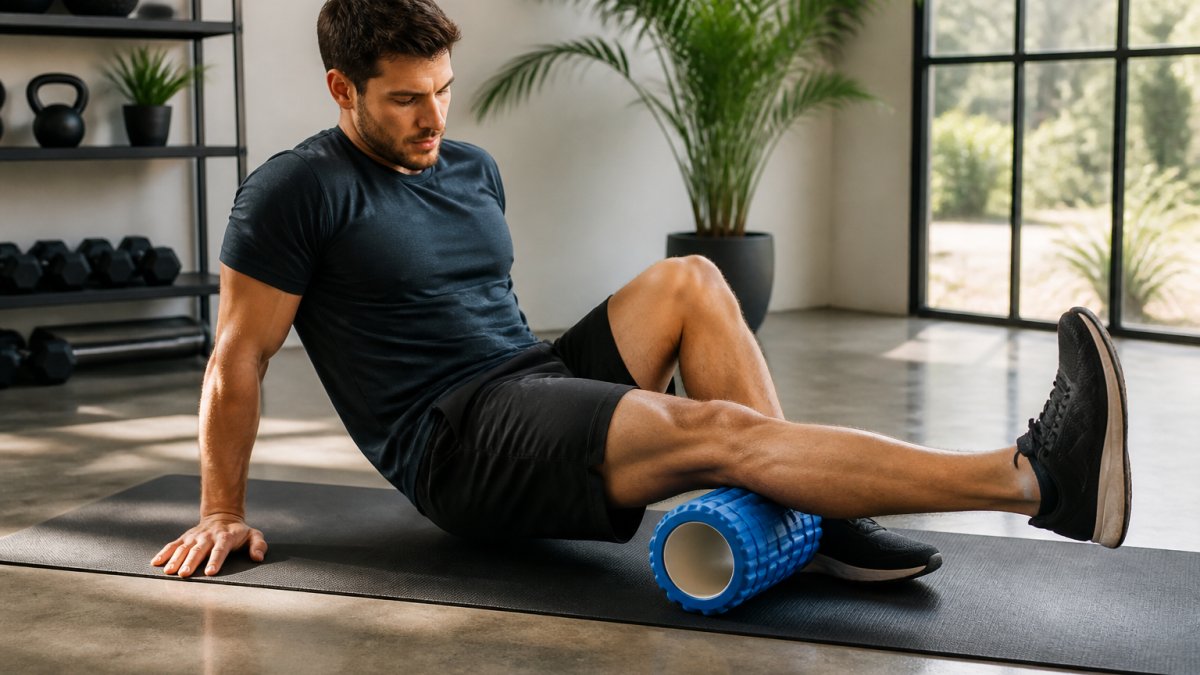
Three rollers cover almost every need: full-body coverage, deep-tissue work, and back tension. The right pick depends on which muscle group keeps sending you the signal, and how much pressure that tissue will tolerate today.
| Roller | Size | Best For | Price |
|---|---|---|---|
| 45cm Yoga Foam Roller | 45 x 13cm | Full-body coverage, legs and back | $15.89 |
| Hexagonal EVA Roller | 9.5cm diameter, 29.7cm long | Deep-tissue knots, calves and quads | $5.43 |
| Muscle Massage Yoga Wheel | 30.5 x 12cm | Back tension and spinal extension | $16.24 |
How We Evaluated These Rollers
Most roundups rank rollers by how aggressive they feel, the wrong axis for tight muscles, because tender tissue usually responds better to moderate, broad pressure than to a hard, narrow spike. We weighed each roller against five practical criteria:

- Comfort under body weight, does the surface stay tolerable for a full 45-second pass, or does it force you to shorten the stroke?
- Grip when damp, does the surface hold position on a sweaty calf or a smooth floor, or does it slide out from under you?
- Pressure distribution, does load spread across a wide band, or concentrate into small points that bruise before they release?
The roller people actually keep using is not the hardest one they own, it is the one that lets them stay on the tissue long enough to get a response.
Which Roller by Body Area and Use Case
Length and diameter matter more than marketing labels. A 45cm roller covers a full quad or both calves at once; a 30cm roller fits a shoulder blade or a single hamstring; a 9.5cm diameter reaches into a calf or forearm a wide roller cannot wrap around.
- Calves and forearms, a compact, smaller-diameter roller (the Hexagonal EVA at 9.5cm) lets you wrap the muscle and control pressure.
- Quads, hamstrings, and both calves at once, a 45cm length saves repositioning time and keeps the stroke continuous.
- Upper back and thoracic spine, a curved profile (the Muscle Massage Yoga Wheel) fits the shape of the spine and supports extension without rolling directly over the lower back.
45cm Yoga Foam Roller: Best for Full-Body Coverage
The 45cm Yoga Foam Roller is our pick for most first-time buyers. Its length covers a full quad or both calves at once, so you spend less time repositioning.
The EVA construction handles back, leg, and muscle relaxation work, but it is not a deep-tissue tool. For aggressive pressure on a specific knot, the hexagonal roller does that job better.
Where it wins is versatility: one roller, most muscle groups, no learning curve.
Hexagonal EVA Roller: Best for Deep-Tissue Knots
The Hexagonal Yoga Roller is the specialist. Its hexagonal nodes and 3D floating massage points reach into tight fascia, and the 35° Shore hardness keeps pressure firm without tipping into bruising territory.
High-density EVA means it holds shape under load, and it supports up to 200 kg, so durability is not the weak point.
The tradeoff is real: those nodes are not pleasant on day one. Build up slowly and keep the roller moving rather than parking on a single node.
Muscle Massage Yoga Wheel: Best for Back Tension
The Muscle Massage Yoga Wheel is the one to reach for when your upper back and spine feel compressed.
Made from TPE and PP, it measures 30.5 x 12cm and comes in purple or grey. Use it for back extension and to ease tension through the whole posterior chain, not for smashing a quad.
If your tightness lives in your mid-back after long days at a desk, this is the tool that changes your evening.
45cm Yoga foam roller muscle massage Block pilates tools Yoga Column fitness →
If Floor Rolling Is Difficult
Not everyone can get down on the floor and back up comfortably. If that is you, the same pressure principles apply with different tools: a handheld roller or massage stick lets you work calves, quads, and forearms seated, and a massage gun reaches a specific knot without floor work. The roller still covers the most ground per dollar, but it is not the only option.
Benefits of Foam Rolling for Athletes
For athletes, the case for rolling is about readiness, not miracles. Foam rolling reliably changes how a muscle feels and how much range you can access right now. It does not repair tissue, speed healing in any proven way, or prevent injury on its own.
Here is what the evidence most consistently supports, and what it does not.
What Foam Rolling Can Do
- Improve short-term range of motion. A few minutes of rolling before training can help you hit positions you would otherwise fight, likely through a combination of reduced stiffness and a nervous-system response rather than any permanent change to the tissue.
- Reduce the sensation of tightness. The feeling of a locked calf or quad often eases after rolling, which matters because that sensation can change how you move and how confident you feel under load.
- Support circulation and warm-up. Rolling raises local blood flow and tissue temperature, making it a reasonable part of a pre-training routine alongside a proper warm-up.
What Foam Rolling Cannot Do
- It cannot lengthen a muscle permanently. Any range-of-motion gain is temporary and fades within minutes to hours unless you follow it with strength or mobility work.
- It cannot prevent injury by itself. Injury prevention comes from load management, strength, and technique, not from a roller.
- It cannot speed recovery in any proven, meaningful way. It may make soreness feel better, but feeling better is not the same as recovering faster.
Why Athletes Still Roll
CrossFit athletes, lifters, and cyclists see the biggest returns in the calves, quads, and thoracic spine, the areas that accumulate load fastest. Yoga practitioners use it to protect range of motion between sessions.
What matters most is consistency. A short daily routine beats a long session once a week, and a roller you actually use beats a harder one you avoid.
NHS guidance on muscle soreness and recovery
How Long to Foam Roll Each Muscle Group
The practical answer is 30 to 60 seconds per muscle group, once or twice a day. Longer is not better, grinding a calf for ten minutes is past the point of useful input.
A simple full-body routine:
- Calves: 45 seconds per side
- Quads: 45 seconds per side
- Hamstrings: 30 seconds per side
- Glutes: 30 seconds per side
Keep pressure at a level you can breathe through. If you are holding your breath, ease off.
Foam Roller vs Massage Gun for Recovery
A foam roller and a massage gun do different jobs, and most serious athletes end up owning both. A roller covers large areas, calves, quads, back.
Rollers are better for pre-workout mobility work and broad post-workout tension. Massage guns are better for targeted, on-the-go relief and for people who travel constantly. If you only buy one, buy the roller. It costs less and covers more ground.
Safe Technique and Areas to Avoid
Most rolling injuries come from technique, not equipment. Move slowly, roughly 2 to 3cm per second, and pause on tight spots rather than bouncing over them.
Avoid rolling directly over:
- The lower back, where there is no bony protection for the spine
- The neck
- Joints, including the knee and elbow
- Acute injuries, bruises, or swollen tissue
If you are rehabilitating an injury, clear your routine with your physiotherapist first. Rolling is a maintenance tool, and it should not be self-prescribed for a diagnosed problem.
What Foam Rolling Can and Cannot Do
Foam rolling can improve short-term range of motion, reduce the feeling of tightness, and support circulation. It can make a stiff calf or quad feel usable again before training.
It cannot lengthen a muscle permanently, fix a structural issue, or replace strength work. The tightness you feel is often a strength or control problem wearing a costume. Rolling manages the symptom; training fixes the cause, the honest version worth building your routine around.
Cleveland Clinic overview of foam rolling
Frequently Asked Questions
Is it okay to foam roll sore muscles?
Yes, foam rolling sore muscles is generally safe and can help reduce stiffness and improve circulation. Use a soft or moderate-density roller and roll slowly over tender areas for 30-60 seconds per muscle group. Avoid rolling directly on acute injuries, bruises, or swollen joints. If pain worsens during or after rolling, stop and consult a healthcare professional.
Is a firmer foam roller better for tight muscles?
Not always. A firmer roller applies more pressure, which can be too intense for tender or inflamed areas. For tight muscles, start with a moderate-density roller like the Hexagonal EVA Roller (Shore 35°) and progress to firmer options as your tolerance improves. Soft rollers are better for beginners and sensitive spots, while firm rollers suit experienced users targeting deep knots.
How often should you use a foam roller for muscle recovery?
Most athletes benefit from foam rolling daily or every other day, especially after training. For general tightness, 5-10 minutes per session is enough. If you're targeting specific muscle groups, spend 30-60 seconds per area. Consistency matters more than duration; short, regular sessions beat occasional long ones.
What is the difference between a smooth and textured foam roller?
Smooth rollers provide even, gentle pressure and suit beginners or sensitive areas. Textured rollers, like the Hexagonal EVA Roller with 3D floating massage points, mimic deep-tissue massage and reach tighter knots. Textured surfaces can be more intense, so start with light pressure and avoid bony areas. Choose smooth for recovery, textured for targeted relief.
Can a foam roller replace a massage gun?
No, they serve different purposes. A foam roller covers large muscle groups and helps with overall mobility, while a massage gun targets precise knots with percussive therapy. For recovery, many athletes use both: a roller for post-workout flush and a massage gun for spot treatment. The best choice depends on your specific tightness and travel needs.
Tight muscles rarely announce themselves at a convenient time. They show up the morning after a heavy session, mid-flight, or halfway through a set you should have owned. Vitalyns builds recovery gear for exactly those moments, with a system spanning five collections of mobility tools designed to help you reset, move better, and recover faster. Start with the roller that matches your tightest area, then explore the wider range at Vitalyns. EXPLORE NOW.